Digital competency management
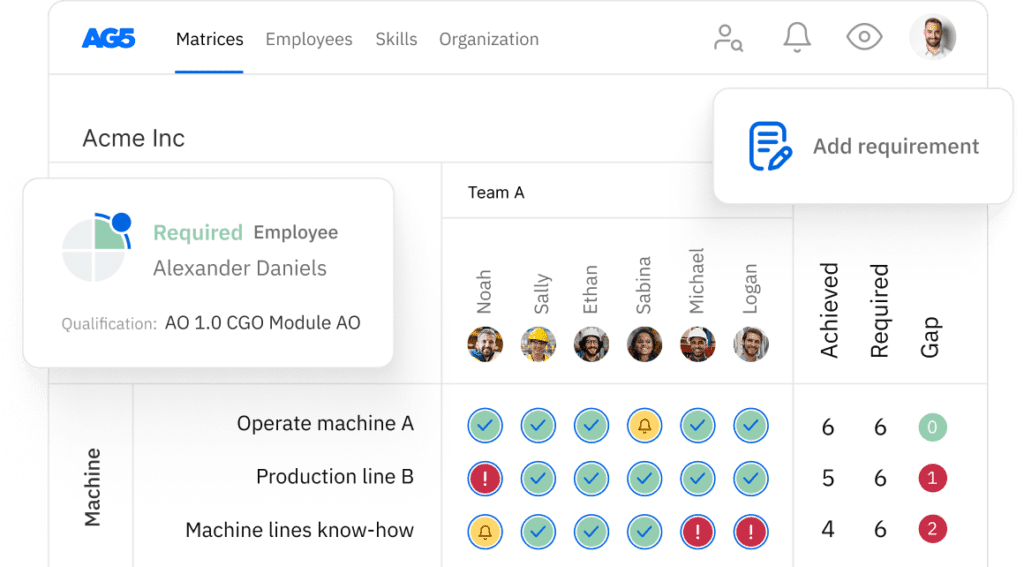
Paper records and spreadsheets stop coping at scale. Digital competency management runs the whole process in connected software, so the matrix stays live, certifications never lapse unnoticed, and audit evidence is always ready. Here’s what changes, and where AI fits.

 Reviewed by Adam Kohut
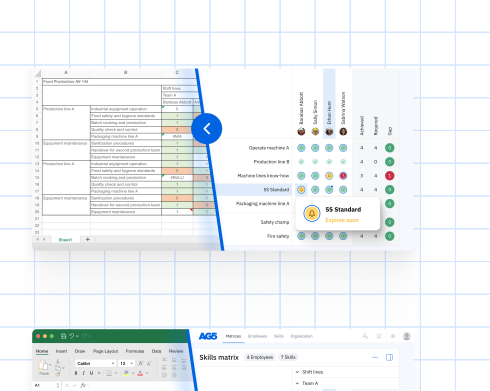
Digital competency management is the practice of defining, assessing, tracking, and developing your workforce’s competencies in connected software, rather than on paper, in binders, or across a pile of spreadsheets. The term gets used loosely, so it is worth being precise: it covers both how you manage competencies, by moving the whole process into a live digital system, and increasingly what you manage, as the digital skills a modern workforce needs grow faster than any manual record can keep up with. It is competency management brought up to the speed the work now runs at.
For manufacturers and regulated-industry teams, the shift to digital is not a matter of tidiness. It is the difference between knowing who is qualified to do what, right now, across every site, and hoping the last person to touch the spreadsheet got it right.
Why competency management went digitalCopied
The honest reason is that the old way stopped coping. A spreadsheet is a reasonable place to record competencies for one team. It falls apart at scale, and it falls apart in exactly the ways that matter most in regulated work.
A spreadsheet cannot tell you, on its own, that a welding certification expires in two weeks. It cannot show a line manager only their team while a quality lead sees the whole site.
It keeps no defensible record of who changed what and when, which is the first thing an auditor asks for. And once several versions exist across a few sites, nobody is certain which one is true. At that point the spreadsheet has stopped being a record and become a risk. Going digital is how businesses close that gap, which is why a dedicated competency management system exists in the first place.
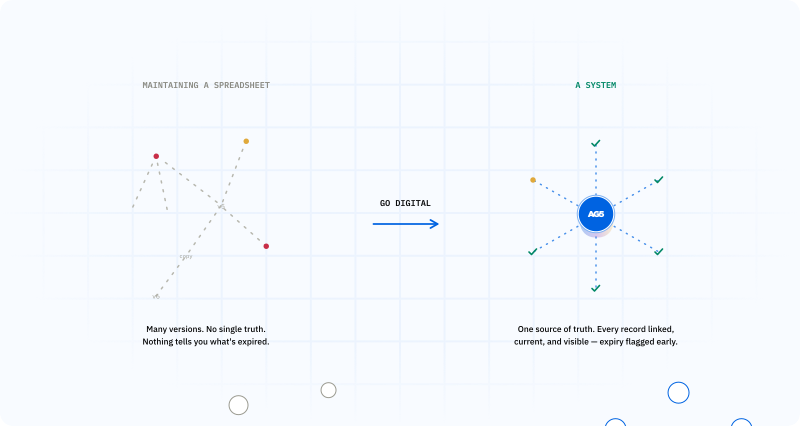
The move to digital is the same move auditors and operations leaders have been pushing for years: stop managing critical workforce data in tools that were never built to hold it.
What “digital” actually changesCopied
Moving competency management into a proper system changes four things in practice, and none of them are cosmetic.
The matrix becomes live. Instead of a snapshot that is out of date the moment it is saved, a competency matrix updates as assessments happen, so the picture is current when someone needs it. Expiry stops being a surprise, because the system tracks certification and qualification validity and alerts you before something lapses, rather than after an auditor finds it.
Visibility becomes role-aware, so a shift lead sees their team, a site manager sees the site, and a group quality director sees everything, each without wading through the others’ data. And the audit trail builds itself, logging every change as a byproduct of normal work, so the evidence an inspector wants is already there.
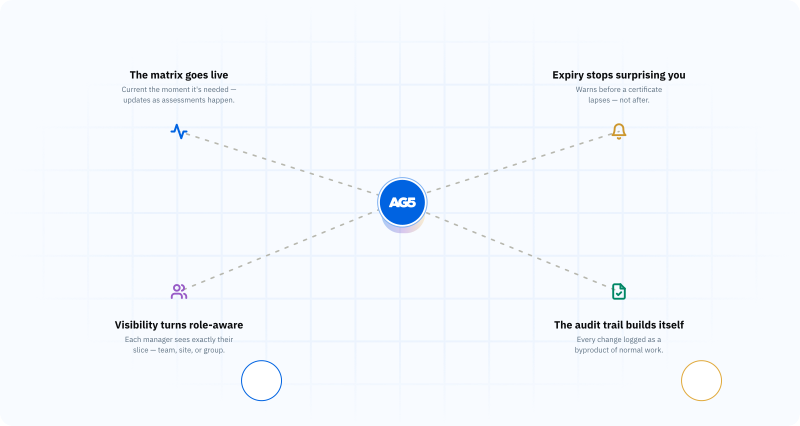
Put together, those four changes are why digital competency management is worth the move. It turns a static document that decays into a system that stays accurate on its own.
The other half: managing digital-era competenciesCopied
There is a second meaning hiding in the term, and it is the one most businesses underestimate. As factories and labs digitize, the competencies the workforce needs are changing fast, and a lot of them are themselves digital.
The operator who ran a manual machine five years ago now supervises a semi-automated cell, reads data off a screen, and works alongside a cobot. Maintenance technicians troubleshoot programmable controllers and networked sensors, not just mechanical faults. Quality teams pull from digital work instructions and manufacturing execution systems rather than paper travellers.
Each of these is a new competency, and each carries its own proficiency levels and its own training need. Data literacy on the shop floor, basic competence with automation and robotics, familiarity with digital work instructions, and a working awareness of operational-technology security are now real requirements in industries that, a decade ago, had none of them.
This is where digital competency management earns its keep twice over. You need a digital system to track competencies at all at scale, and you increasingly need it to track competencies that did not exist when your last framework was written. The businesses that struggle are the ones treating digital skills as something that will sort itself out, while the equipment on the floor gets more digital every year.
Keeping the framework current with these new requirements is itself an ongoing job, and it is one reason a structured implementation matters more now than it used to.
The impact of AI on competency managementCopied
AI is the newest force acting on all of this, and it is worth being clear-eyed about what it does and does not change. PwC has found that jobs most exposed to AI are changing far faster than those that are not, which is exactly why a static, annual skills record cannot keep up with the work.
What it helps with is the slow, manual work around the edges. AI can read job descriptions and training records and suggest a draft set of competencies for a role, which turns a blank page into something to edit. It can flag likely skills gaps across a workforce faster than a person reviewing matrices by hand.
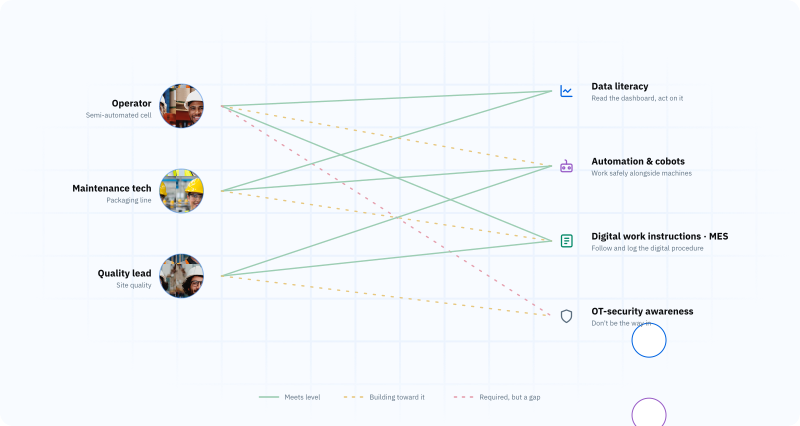
It can match people to tasks based on the competencies they hold, and surface patterns, like a critical skill quietly concentrated in one person, that are easy to miss. For the administrative weight that has always made competency management feel heavy, this is genuine progress.
What it does not change is the part that matters most in regulated work: the evidence. An auditor does not accept that an algorithm inferred someone was probably competent. The standards, ISO 9001 clause 7.2, AS9100, GMP, still require assessed, signed-off, documented competence, and that sign-off has to come from a qualified human who is accountable for it. AI can tell you where to look and draft what to check. It cannot certify that an operator is safe to run the line, and treating its suggestions as conclusions is how a business talks itself into a false sense of control.
So the sensible position is to let AI take the admin and the prompting, and keep the assessment and the accountability human. Used that way, it makes competency management faster without making it less defensible. Used the other way, it quietly reintroduces exactly the risk the discipline exists to remove.
How to go digital without making it worseCopied
If you are moving competency management into a system for the first time, the trap is to digitize the mess rather than fix it. Define the competencies that genuinely gate the work first, baseline your people honestly, and only then put it into software, so what you build is a clean record rather than a faster version of a bad one. The full method is in our guide on how to implement competency management, and when you are ready to compare tools, our roundup of the best competency management software sets out what to look for.
Written by: Rick van Echtelt
Copy edited by: Adam Kohut
FAQs Copied
What is digital competency management?
Is digital competency management the same as competency management software?
What digital skills does a modern workforce need?
How is AI changing competency management?
Do spreadsheets count as digital competency management?
Author Copied
Revisions Copied