Cross-training employees in manufacturing: The multiskilling playbook
Cross-training builds a versatile, resilient workforce. Plan multiskilling with a cross-training matrix and roll it out on the floor.

 Reviewed by Adam Kohut
What is cross-training (and multiskilling)?Copied
Cross-training is the practice of teaching employees skills beyond their primary role so they can cover more than one task, station, or machine. In manufacturing, the result is a multiskilled workforce that keeps production lines running through absences, turnover, and demand swings.
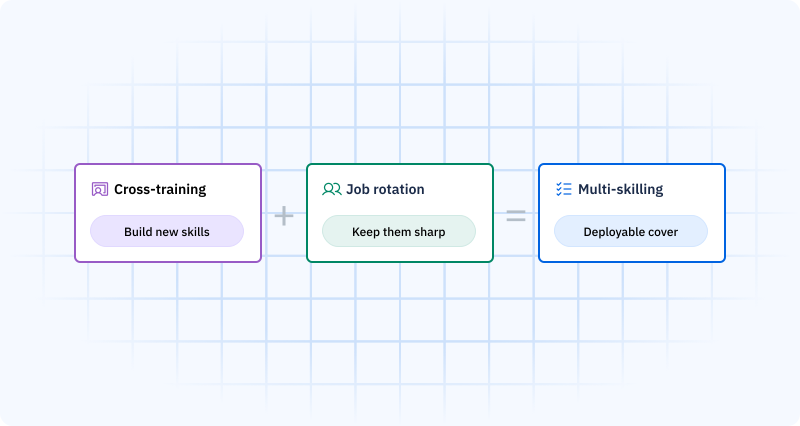
The two terms are often used interchangeably, but they name different things. Multiskilling is the outcome, operators who hold several qualified skills. Cross-training is the activity that produces it. Job rotation is a third concept that gets tangled in: rotation is the scheduled movement of people between stations they are already qualified for. It keeps existing skills fresh, while cross-training builds new ones. A mature manufacturing skills program uses both, in that order.
Stations are the classic unit, but the same logic covers maintenance technicians certified across machine families, quality inspectors trained on multiple product lines, and warehouse staff qualified on different equipment classes. Anywhere a skill is scarce and the work is continuous, cross-training applies.
Why it matters: downtime, absence cover, key-person riskCopied
Downtime is the most expensive thing that happens on a production floor. Siemens’ True Cost of Downtime 2024 report puts the loss from unplanned downtime at nearly $1.5 trillion a year for the world’s 500 largest companies, around 11% of their revenues, with a single lost hour in automotive costing roughly $2.3 million. Machines cause many of those stoppages. People cause the rest: when only one person can run a station, every sick day, vacation, and resignation is a potential line stop.
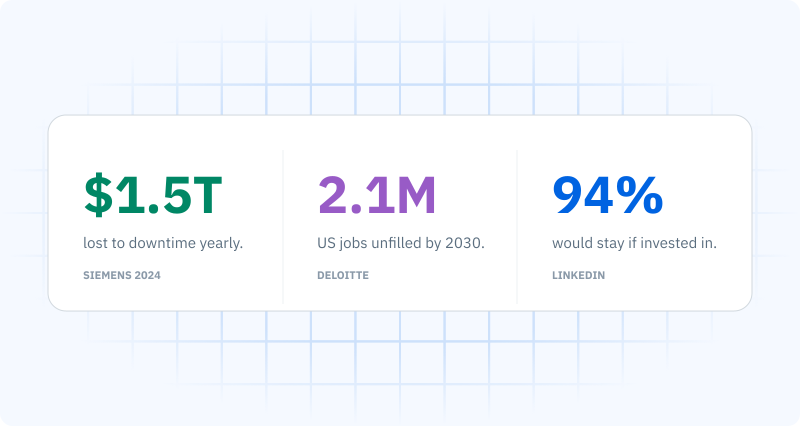
The labor market makes single-skill staffing riskier every year. Deloitte and The Manufacturing Institute project that as many as 2.1 million US manufacturing jobs could go unfilled by 2030. You cannot reliably hire your way out of a coverage gap; building versatility in the people you already have is the lever you control.
There is a quieter cost that never reaches a downtime report: covering gaps with overtime and temporary labor. Overtime premiums inflate cost per unit, temps need supervision and still make more errors, and both are recurring expenses that a one-time investment in cross-training steadily replaces.
The benefits stack up across operations and HR:
- Absence and vacancy cover. Any qualified operator can step in, so the line holds its output while a role sits open or someone is out.
- Reduced key-person risk. No critical station depends on one individual, which is the quiet failure mode behind many “unexplained” productivity dips. Workforce readiness stops being a guess and becomes a number.
- Faster changeovers and rebalancing. Supervisors can flex people toward bottlenecks instead of watching one station starve the line.
- Higher retention. Learning is a stay-factor: in LinkedIn’s 2018 Workplace Learning Report, 94% of employees said they would stay at a company longer if it invested in their careers. Gallup estimates replacing an employee costs one-half to two times their annual salary, so every resignation you prevent is real money.
- Better problem-solving. Operators who know adjacent stations understand the line as a system, and they spot upstream causes that single-station specialists miss.
The cross-training matrix: who learns whatCopied
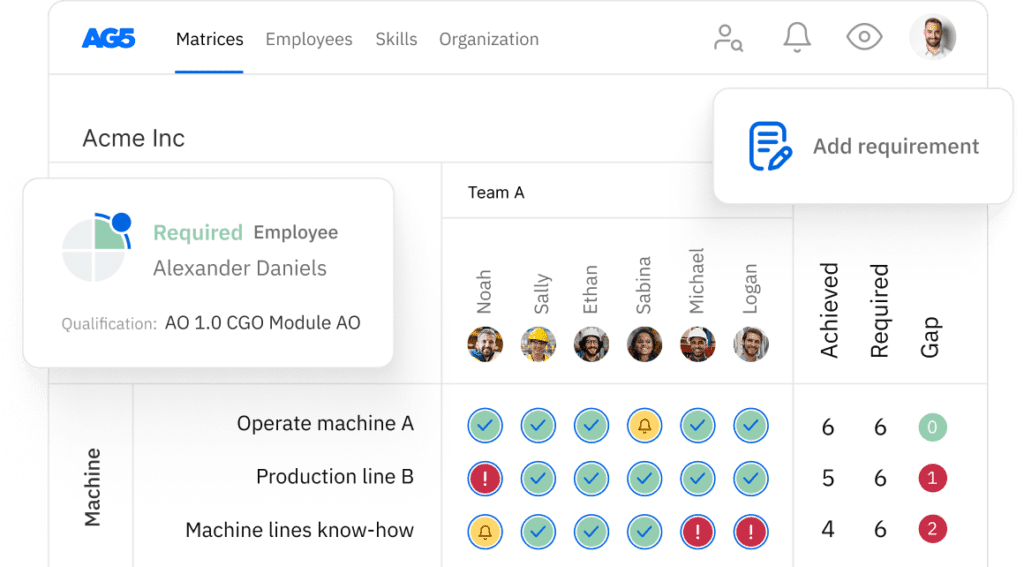
A cross-training matrix is a grid: people down the side, skills or stations across the top, and a proficiency level in each cell. It is the single most useful artifact in a multiskilling program because it turns an abstract goal (“be more flexible”) into visible, specific gaps.
Scale: 0 = not trained, 1 = awareness, 2 = performs with supervision, 3 = performs independently, 4 = qualified to train others.
Read it column by column and the risks announce themselves. Welding has one independent operator; if Priya is out, the station is down. Quality inspection looks healthy until you notice both qualified people also carry other scarce skills. This is exactly the analysis skills matrix software automates: a live matrix flags one-deep stations continuously, where a spreadsheet version decays the week after someone builds it.
Rows tell the other half of the story. Reading across, Deshawn is solid on two stations but has nothing new in progress, which makes him the natural candidate for the welding gap. Maria is at or near trainer level on three stations, so the plan should protect her hours for teaching rather than hand her a fourth qualification. Columns expose the plant’s risk; rows shape each person’s development path.
Build the first version in an afternoon, not a quarter. List critical stations, pull qualification records, and have supervisors validate levels against sign-off criteria rather than memory. The matrix does not need to be perfect to be useful. It needs to be current.
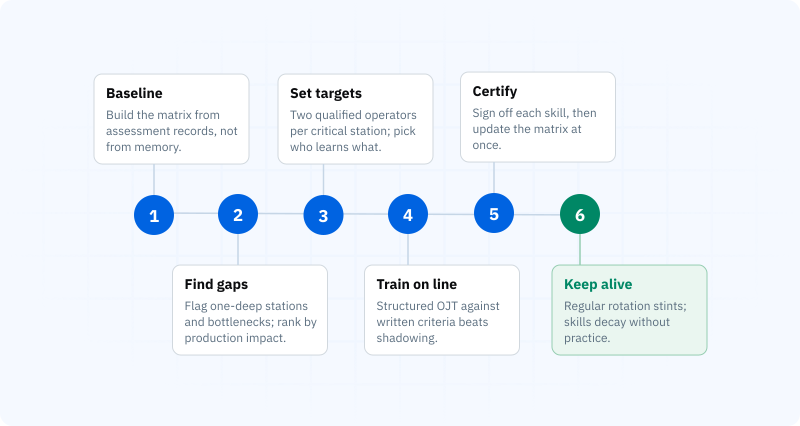
How to roll out a program in 6 stepsCopied
- Baseline current skills. Build the matrix from assessment records and certifications, not from memory. Supervisors consistently overestimate coverage until they see it in a grid.
- Find the gaps that hurt. Use skill gap analytics to identify one-deep stations, chronic bottlenecks, and skills held mainly by people close to retirement. Rank them by production impact, not alphabetically.
- Set coverage targets and pick pairings. A practical target: at least two qualified operators per critical station. Then choose who learns what based on aptitude, interest, and shift patterns. Volunteers learn faster than conscripts.
- Train on the line with qualified trainers. Structured on-the-job training against written criteria beats shadowing by osmosis. Protect the training hours in the production schedule; unprotected training time is the first thing a busy week deletes.
- Certify and record. Sign off each new skill against the same criteria you would use for a new hire, then update the matrix immediately. An out-of-date matrix quietly reintroduces the risk you built it to remove.
- Keep skills alive with planned rotation. Qualifications decay without practice. Schedule regular stints on secondary stations, which is where job rotation earns its place as cross-training’s maintenance program.
Resist the urge to launch plant-wide. Pilot on one line or cell for a quarter. The pilot surfaces practical frictions, trainer capacity, scheduling conflicts, sign-off disagreements, while the stakes are small, and a line that visibly runs smoother through vacation season sells the program to the rest of the floor better than any slide deck.
Measuring impact: Versatility, OEE, retentionCopied
Measure a baseline before the program starts, or you will never prove it worked. Three families of metrics cover it.
Versatility. Average number of stations each operator is qualified for, and the percentage of critical stations with at least two qualified operators. These are the program’s direct outputs, and they should move within a quarter. A simple versatility index keeps the trend honest: divide the count of level-3-or-higher qualifications by the number of operators. The example matrix earlier holds 8 such qualifications across 4 people, an index of 2.0; a line starting near 1.0 can realistically reach 1.5 within a year without straining production.
OEE and flow. Watch the availability component of OEE, plus absence-related line stops, changeover duration, and time-to-cover when someone calls in sick. Cross-training shows up here as stoppages that no longer happen, so trend data matters more than any single week. Make “no qualified operator available” a standing category in your downtime codes; it is the exact line item this program exists to erase, and you want to watch it shrink.
Retention and pipeline. Compare turnover between cross-trained operators and the rest of the workforce, and track internal fill rates for open roles. Add pipeline health measures too: how many people are currently in training, and the average time from starting a skill to sign-off.
Pitfalls to avoidCopied
Training everyone in everything. Coverage follows risk, not ambition. Two or three deep on critical stations beats a shallow layer of half-skills across the whole floor, and it costs far less.
No sign-off standard. “Shadowed Dave for a week” is not a qualification. Define observable criteria and require formal sign-off, or the matrix fills with ratings nobody can defend.
Letting skills decay. A qualification earned in January and never practiced is fiction by December. Rotation schedules exist to stop the matrix from drifting away from reality.
Overloading your best people. Level-4 operators end up training others while still carrying production targets. Plan their capacity explicitly or you will burn out the exact people the program depends on.
Ignoring recognition and pay. Multiskilled operators know their market value. Skill-based pay steps, or at minimum visible recognition, keep the versatility you built from walking to a competitor who rewards it.
No backfill plan for training hours. Every hour a learner spends at a new station is an hour their home station needs cover. Programs that skip this math collapse quietly, because supervisors under output pressure will always reclaim the training slot unless the schedule explicitly protects it.
Tracking it all in a spreadsheet. Version-controlled chaos across shifts and sites is the default failure mode. A live system keeps qualifications, expirations, and coverage visible to the people making daily staffing calls.
FAQs Copied
-
What is the difference between cross-training and job rotation?
-
How many stations should each operator be cross-trained on?
-
How do you track cross-training progress?
-
Does cross-training reduce downtime?
Author Copied

Revisions Copied
Written by: Rick van Echtelt
Copy edited by: Adam Kohut