Competency assessment: Methods, process, and a free template
A competency assessment evaluates skills, knowledge, and behaviors against role requirements. Compare methods and follow a 5-step process.

 Reviewed by Adam Kohut
What is a competency assessment?Copied
A competency assessment is a structured evaluation of an employee’s skills, knowledge, and behaviors against the requirements of their role. It measures how well someone performs defined tasks, usually on a rating scale, and produces evidence that HR, managers, and auditors can act on.
The scope is what sets it apart from a job skills assessment, which focuses narrowly on whether someone can execute specific tasks. Competency covers the full picture: technical ability, underlying knowledge, and the behaviors that determine whether the work gets done safely and consistently. That breadth is why competency assessments anchor qualification sign-offs, promotion decisions, and audit evidence in regulated industries.
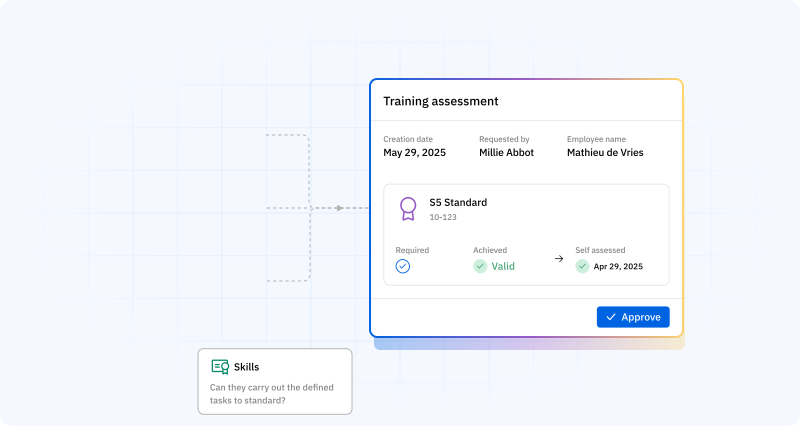
Frequency varies with stakes. A pharmaceutical or aerospace operation may assess every operator against critical competencies annually, while an office role might see one structured evaluation per appraisal cycle. The constant is that some decision, about safety, quality, promotion, or pay, hangs on the result.
Why and when to run a competency assessmentCopied
The core reason is simple: you cannot manage what you have not measured. Development conversations, training budgets, and staffing decisions all rest on assumptions about who can do what. An assessment replaces those assumptions with rated, evidenced data.
Certain moments demand one. Before an employee works independently on safety-critical or regulated tasks, competence has to be demonstrated and documented; ISO 9001 clause 7.2, for instance, requires organizations to determine, ensure, and evidence the competence of people whose work affects quality. Other common triggers include the end of onboarding, a promotion or role change, the introduction of new equipment or procedures, audit preparation, and the annual development cycle.
The pattern across all of them: someone is about to rely on this person’s competence, so the organization needs to know, not hope, that it is there.
Picture the audit version. An inspector points at a batch record and asks who verified the fill weights, then asks how the company knows that person was competent to do it. With assessments in place, the answer is a dated record with criteria, an assessor’s name, and attached evidence. Without them, the answer is a job title and an awkward pause, and the finding writes itself.
Competency assessment methods comparedCopied
No single method fits every competency. The five below cover most situations, and mature organizations combine them.
Pairing methods offsets their individual weaknesses. A common frontline pattern is manager assessment plus a practical test: the observation confirms day-to-day performance, the test confirms the person can do the task to standard when it counts.
Cost and cadence matter as much as fit. Self-assessments are cheap enough to run quarterly across everyone; practical tests are expensive enough to reserve for initial sign-off, requalification, and any competency where failure hurts someone. A useful rule: the higher the consequence of a wrong rating, the more expensive the method you should accept, and the less anyone should be rating themselves.
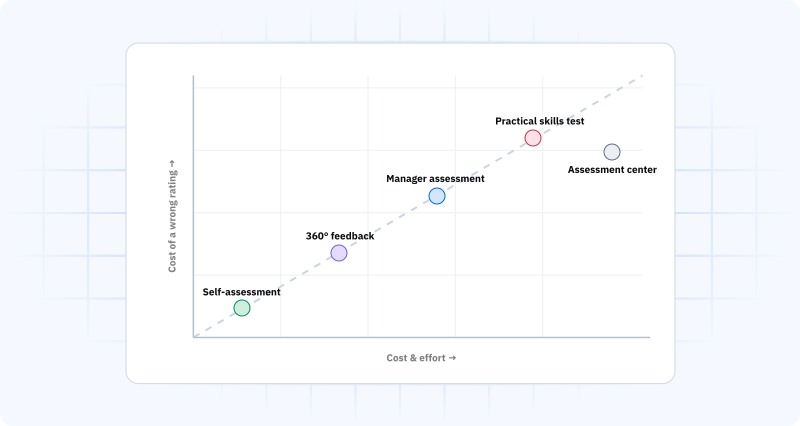
Watch for what each method cannot see. Manager assessments miss competencies the manager never observes, like how someone handles a night-shift breakdown. Peer feedback catches collaboration but cannot certify technical standards. Practical tests capture a moment, not a trend. Combining methods covers the blind spots, which is the real argument for mixing them rather than crowning one.
How to conduct a competency assessmentCopied
- Define the competencies for the role. Draw them from role profiles, SOPs, and your competency framework, and write each one as observable criteria. “Understands changeover procedure” is not assessable; “completes a format changeover within the standard time, unassisted” is.
- Set the rating scale and the passing standard. Decide what each level means before anyone is assessed, and define the minimum level the role requires. A defined competency proficiency scale keeps two assessors from reading “level 3” two different ways.
- Choose the method and prepare the assessors. Match the method to the competency type using the comparison above. Then calibrate: have assessors rate the same sample cases and reconcile differences before live assessments start.
- Run the assessment and record the evidence. Capture the rating plus what backs it up: an observation checklist, a test result, a certificate. Store both in a competency management system rather than a spreadsheet, because an unevidenced rating is an opinion, and opinions fail audits.
- Review results and act on them. Share the outcome in a feedback conversation, agree on development actions for any gaps, and set a re-assessment date. An assessment that leads nowhere teaches employees to stop taking the process seriously.
A worked example: Line changeover
Applying the five steps to one competency shows what the process looks like in practice. A beverage plant defines “performs a format changeover on line 2” with criteria drawn from the SOP: correct lockout, correct tooling sequence, all verification checks completed, and the whole job done within 45 minutes. The required level is 3 on the plant’s four-point scale.
The method chosen is a practical test observed by a level-4 operator, because changeovers are both technical and time-critical. During the test, the candidate completes the sequence but skips one verification check. The assessor records level 2, attaches the timed checklist as evidence, and books a re-test after two supervised runs. Total cycle: under two hours per operator, after which the plant knows, rather than assumes, who can run changeovers unsupervised.
Rating scales & avoiding biasCopied
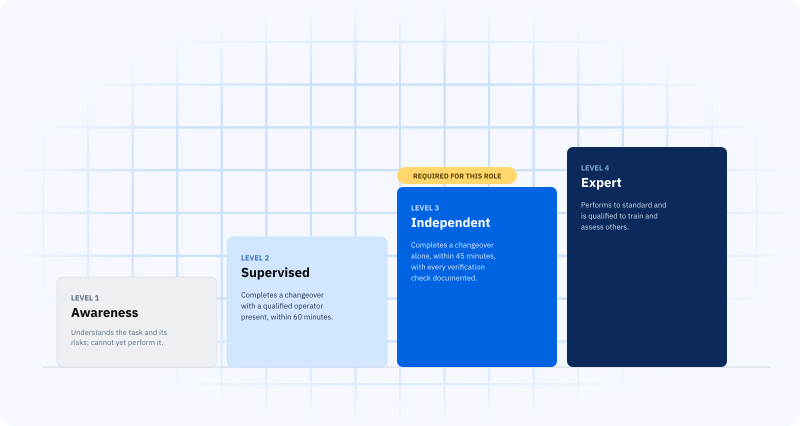
A four-level scale is the workhorse of frontline competency assessment:
- Level 1: Awareness. Understands the task and its risks; cannot yet perform it.
- Level 2: Supervised. Performs the task under supervision.
- Level 3: Independent. Performs the task alone, to standard, reliably.
- Level 4: Expert. Performs to standard and is qualified to train and assess others.
The scale only works when each level is anchored to observable behavior for each competency. Vague labels invite bias, and assessment bias comes in predictable forms: halo effect (one strength inflates every rating), leniency and severity (assessors who rate everyone high or low), central tendency (everything scores in the middle), and recency (last month’s performance outweighs the last year).
Anchoring means writing levels in task terms. For the changeover competency above, level 2 reads “completes a changeover with a qualified operator present, within 60 minutes,” while level 3 reads “completes a changeover alone, within 45 minutes, with every verification check documented.” Nobody interprets adjectives; they compare what happened against what is written.
Unmanaged bias does more than distort individual ratings; it corrupts the aggregate. A department whose assessor rates leniently looks stronger than one with an honest assessor, so training budget and succession attention flow to the wrong place.
Four countermeasures handle most of it. Write criteria you can observe. Require evidence for every rating. Calibrate assessors against shared examples. And for high-stakes sign-offs, use two assessors rather than one.
Calibration is not a one-time event, either. Assessor drift creeps back within a couple of cycles, so revisit the shared examples at least annually and whenever someone new joins the assessor rotation.
Turning results into development plansCopied
Assessment data pays off twice. At the individual level, each gap maps to a targeted action: mentoring, structured on-the-job training, a course, or stretch assignments, recorded in an employee development plan with a re-assessment date attached. The re-assessment is what distinguishes development from paperwork.
At the aggregate level, the same data becomes a heat map of team capability. Clusters of low ratings point to training priorities. A critical competency held by one person signals succession risk. Strong ratings in unexpected places reveal internal candidates you would otherwise recruit externally.
The aggregate view also changes how training gets bought. If eleven of fourteen operators score below target on the same competency, the answer is a structured internal program with a qualified trainer, not eleven seats on an external course. If two people miss the mark, coaching closes the gap for a fraction of the cost. Assessment data lets L&D match the intervention to the shape of the problem instead of defaulting to a catalog.
Close the loop visibly. When employees see assessments lead to real development, participation improves, and so does the honesty of self-assessments the next time around.
Set re-assessment intervals by risk, not calendar convenience. Safety-critical competencies typically warrant annual requalification, or an immediate one after an incident or a long absence. Stable technical skills can run on two- or three-year cycles, and behavioral competencies usually track the appraisal rhythm. Whatever the interval, the system should surface due dates on its own, because an expired qualification discovered during an audit costs far more than the re-assessment would have.
Free templateCopied
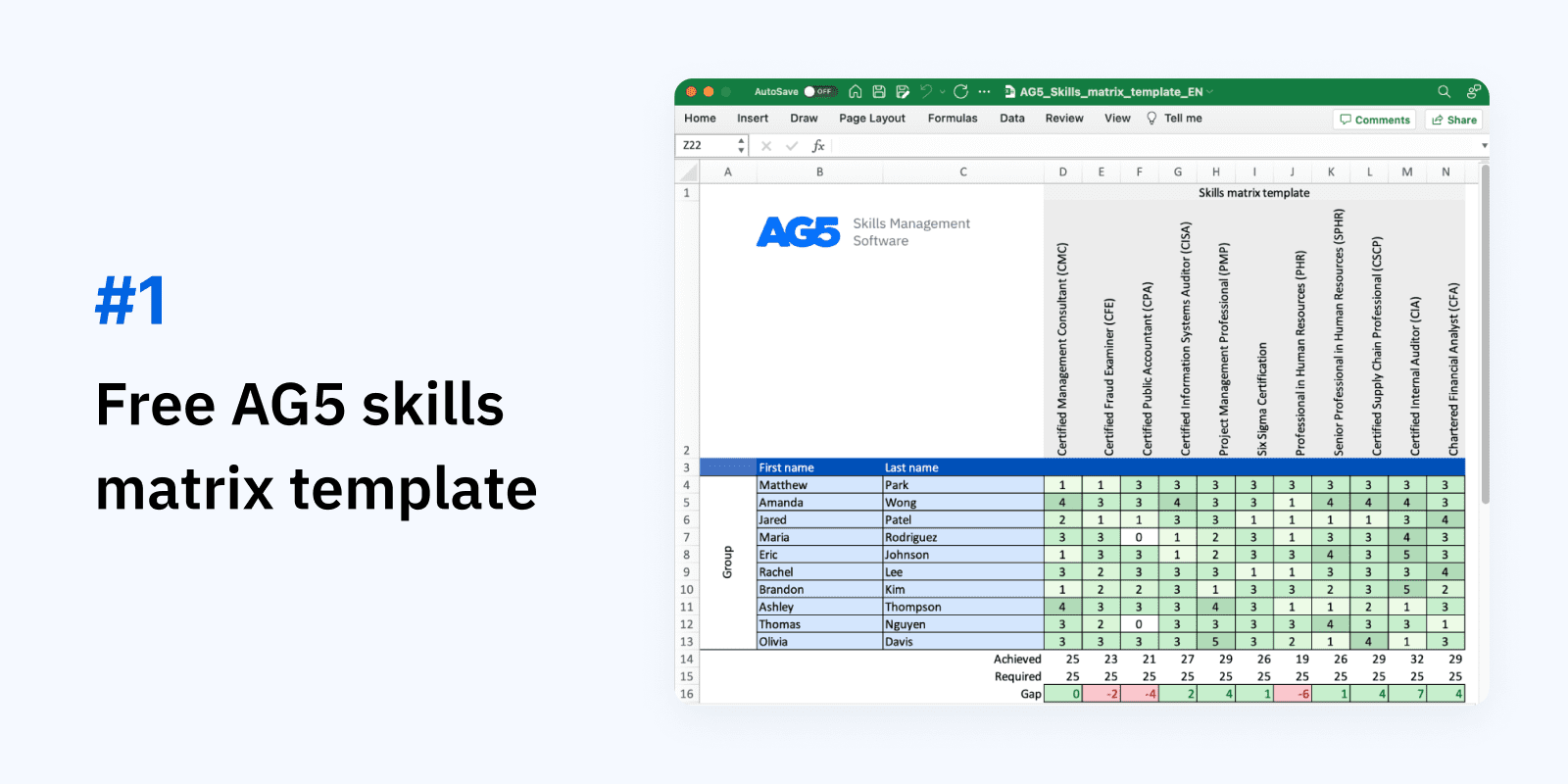
A practical competency assessment template needs a row per competency with these columns: the competency name, its observable criteria, the required level, the assessed level, the evidence reference, the assessor’s name, the assessment date, and the agreed follow-up action. AG5’s free skills matrix templates provide a ready structure for recording and tracking these results across a whole team.
FAQs Copied
-
What is the difference between a competency assessment and a skills assessment?
-
What methods are used in competency assessments?
-
Who should conduct a competency assessment?
-
What does a competency assessment example look like?
Author Copied

Revisions Copied
Written by: Rick van Echtelt
Copy edited by: Adam Kohut