Competency-based performance management
Traditional reviews ask whether someone hit their targets. Competency-based performance management asks a sharper question: can this person do what the role demands, to standard, and what closes the gap if they can’t? Here’s how it works, and how to set it up.

 Reviewed by Adam Kohut
Competency-based performance management is an approach that measures and develops people against the specific competencies their role requires, rather than against generic goals or a manager’s once-a-year impression. Instead of asking, “Did this person hit their targets?” it asks, “Can this person do what the role demands, to the standard the work needs, and what will close the gap if they can’t?” It ties how someone is performing directly to what they are actually able to do. Performance management is one of the five HRM cornerstones, alongside recruitment, training and development, career planning, and pay, and all five get stronger when they rest on the same foundation of accurate competency data.
That distinction sounds academic until you put it on a factory floor. In an office, performance can be a fuzzy blend of output and judgment. Regulated or frontline environments make it far more concrete: can this operator run the line safely, can this technician perform the inspection to standard, is this person signed off for the task in front of them. There, performance and competence are almost the same question, which is why competency-based performance management fits operational businesses far better than the traditional model does. It is one practical expression of competency management applied to how you evaluate and grow your people.
How it differs from traditional performance managementCopied
Traditional performance management tends to run on objectives and ratings, reviewed annually. A manager sets goals, the year passes, and a score gets assigned, often colored by recency and personal rapport. It works reasonably well for roles where output is the whole story.
It works badly for roles where the question is whether someone can perform a defined task correctly. A line operator who hits a productivity target while skipping a quality step has met the objective and failed the job. A traditional review struggles to see that. A competency-based review does not, because it measures the person against the specific abilities the role requires, assessed and evidenced, not against a number that hides as much as it shows.
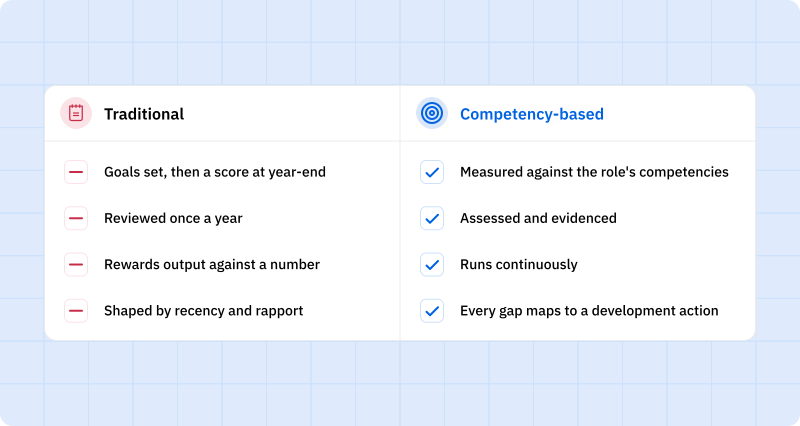
The other difference is timing. Annual reviews assume the world holds still for a year. It does not, especially where automation, new equipment, and changing regulations reshape what a role needs. Competency-based performance management is built to run continuously, which is the only cadence that keeps pace with work that actually changes.
Why it matters in regulated and operational environmentsCopied
In compliance-critical industries, this is not an HR refinement. It is closer to a legal requirement wearing different clothes.
ISO 9001 clause 7.2, ISO 45001, and AS9100 all require you to ensure and evidence that people are competent to do their work, and to act when they are not. That is, in effect, a mandate for competency-based performance management: define the competence a role needs, check each person against it, and close the gap. In pharmaceuticals, an operator’s “performance” is meaningless to an auditor unless it rests on assessed competence against the relevant procedures. In aerospace, a technician’s performance on a special process is only as good as their current qualification for it. The regulator is not asking whether someone worked hard. It is asking whether they were competent to do the task, and whether you can prove it.
This is the angle most performance-management advice misses. It treats competencies as a nice input to a development conversation. In operational businesses, competence is the basis on which someone is allowed to perform the work at all, which makes it the only sensible basis for judging how they are performing it.
How to link a competency framework to performance managementCopied
This is the practical question people actually ask, and most articles skirt it. Here is the method, and it reuses the same building blocks competency management already gives you.
Start with the competencies, not the goals. For each role, define the competencies and the proficiency level the work requires, drawn from your competency framework. This is the standard the person is measured against, and it has to be specific enough to assess. “Good communicator” is not assessable. “Can lead a shift handover that transfers all open quality issues?” is.
Make the standard explicit by setting a target proficiency per competency, so the difference between “Can do this under supervision” and “Can do this alone and train others” is visible rather than implied. The distinction between competency and proficiency matters here, because performance is about the level, not just the presence, of a skill.
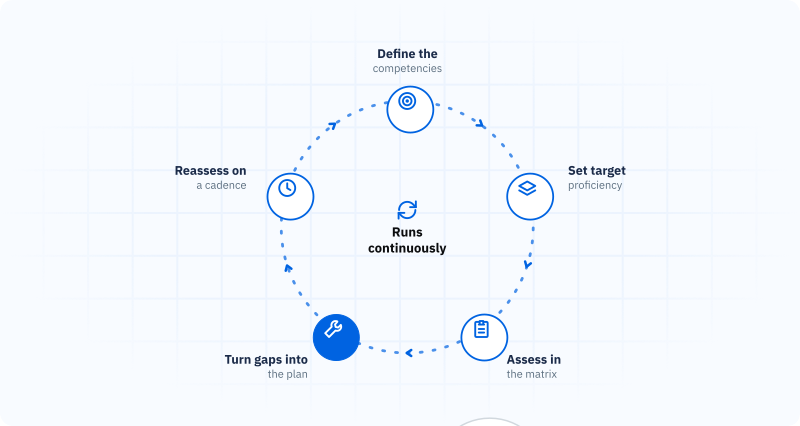
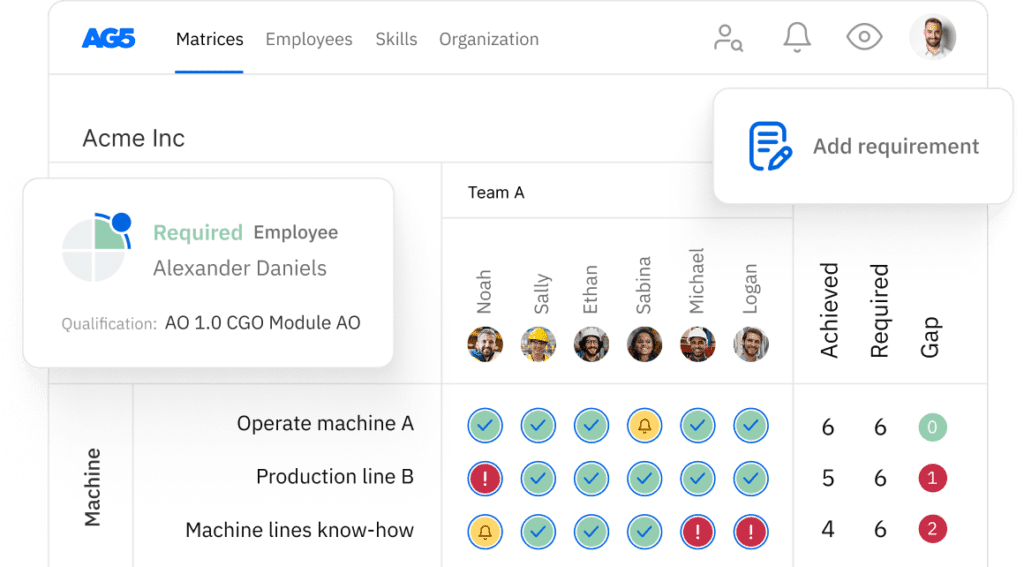
Assess against the standard, and record it where everyone can see it. A competency matrix is the natural home for this, showing each person’s current level against the required level for their role. The performance picture stops being an opinion and becomes a position on a grid you can defend.
Turn the gaps into the development plan. Where someone sits below the required level, that gap is the substance of the performance conversation, and a competency gap analysis prioritizes which gaps matter most. The review stops being a backward-looking verdict and becomes a forward-looking plan, with each gap tied to a specific development action rather than a vague “needs to improve.”
Run it continuously. Reassess on a cadence that matches the role’s risk, and let role changes, new equipment, and incidents trigger a fresh look. A competency-based system that runs once a year is just a traditional review wearing a competency costume.
What a competency-based review looks like in practiceCopied
It helps to see the difference in a real role. Take a maintenance technician on a packaging line, and assume the example is illustrative.
Under a traditional review, the conversation runs on output. Tickets closed, downtime hours, a manager’s sense that the technician is reliable. The technician gets a rating of “Meets expectations,” and both sides move on. Nothing in that review reveals that the technician has never been formally assessed on the new servo-driven changeover system the line adopted six months ago, and has been quietly avoiding it.
Under a competency-based review, the role carries a defined set of competencies with target levels: the role needs the technician to be independent on electrical fault-finding, independent on lockout-tagout, and independent on the new changeover system. The matrix shows the technician independent on the first two, but still only a trainee on the changeover system.
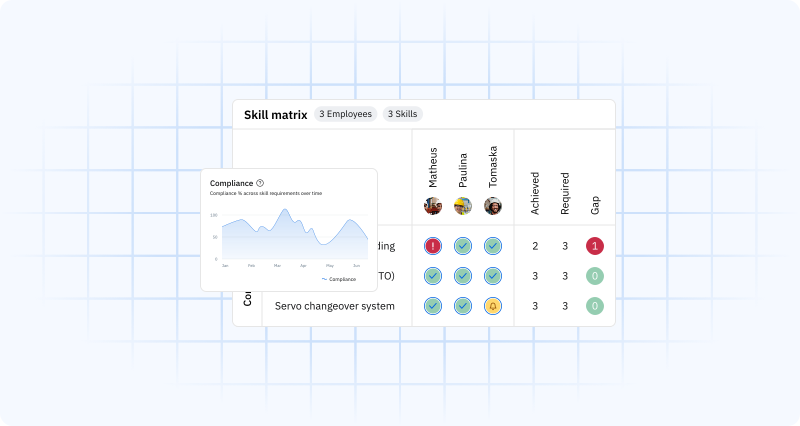
The review is no longer a verdict on whether they are “good.” It is a specific, fair conversation about one gap that matters, on a system the line now depends on, with a development plan attached and a reassessment date set. The technician knows exactly where they stand and how to progress, the manager has an evidenced basis for the rating, and the business has just surfaced a capability risk a traditional review would have missed entirely.
Same technician, same six months. One review told the business almost nothing, the other told it where its next line stoppage was hiding.
The benefits, and who feels themCopied
Done properly, competency-based performance management pays off for three different people at once.
The employee gets a fairer deal, because they are judged against a clear, role-specific standard they can see, with a visible path to the next level, rather than against a manager’s mood in March. Gallup has consistently found only around a third of employees are engaged at work, and clarity about what is expected of them is one of the things that moves that number, which is exactly what a competency-based review provides. The manager gets a defensible basis for difficult conversations, because “you are at trainee level and the role needs to be independent in these two competencies” is a far easier discussion than a subjective rating. And the business gets something the others do not: a direct line between performance, compliance, and continuity. The same data that drives the review also proves competence to an auditor and exposes the single points of failure where one person holds a critical skill.
That last point is why this lands harder in operational businesses than in offices. When Adient reduced its qualification and training admin to around 15 seconds, it was not just saving time, it was making the link between who is competent and who is performing instantly visible, which is the whole point.
Where it goes wrongCopied
A few failure modes show up often enough to name.
The first is confusing behaviors with technical competence. Soft, behavioral competencies have a place, but in regulated work the assessable technical competencies are what protect the business, and a framework that drowns them in vague behavioral language ends up measuring nothing. The second is over-engineering. A performance framework with 60 competencies per role will not get used, and an unused framework is worse than none, because it looks like rigor while delivering none. The third is using it as a stick. Competency-based performance management works when the gap leads to development. The moment it becomes a way to rank and punish people, the assessments stop being honest, and dishonest assessments are useless to everyone, the auditor included.
Avoid those, and the approach mostly runs itself.
Spreadsheets, and the point they breakCopied
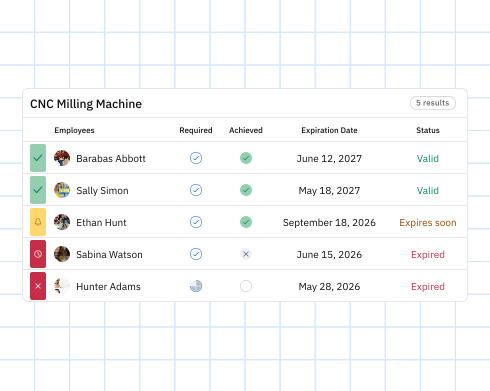
Most teams start tracking this in a spreadsheet, and for a single team it is fine. It stops being fine when you are running continuous assessment across hundreds of people, because a spreadsheet cannot alert you that a qualification underpinning someone’s performance has expired, cannot show a manager only their team, and leaves no trail an auditor will accept. At that scale, competency management software is what makes continuous, evidence-based performance management actually workable, with live assessments, expiry alerts, and records that double as audit evidence.
Written by: Rick van Echtelt
Copy edited by: Adam Kohut
FAQs Copied
What is competency-based performance management?
How does a competency framework link to performance management?
What is the difference between competency-based and traditional performance management?
Is competency-based performance management the same as competency management?
How do competencies fit the performance management cycle?
Author Copied
Revisions Copied