Competency management: The complete guide
Learn what competency management is, how it differs from skills management, the types of competency models, and how to build a programme that actually scales.

 Reviewed by Adam Kohut
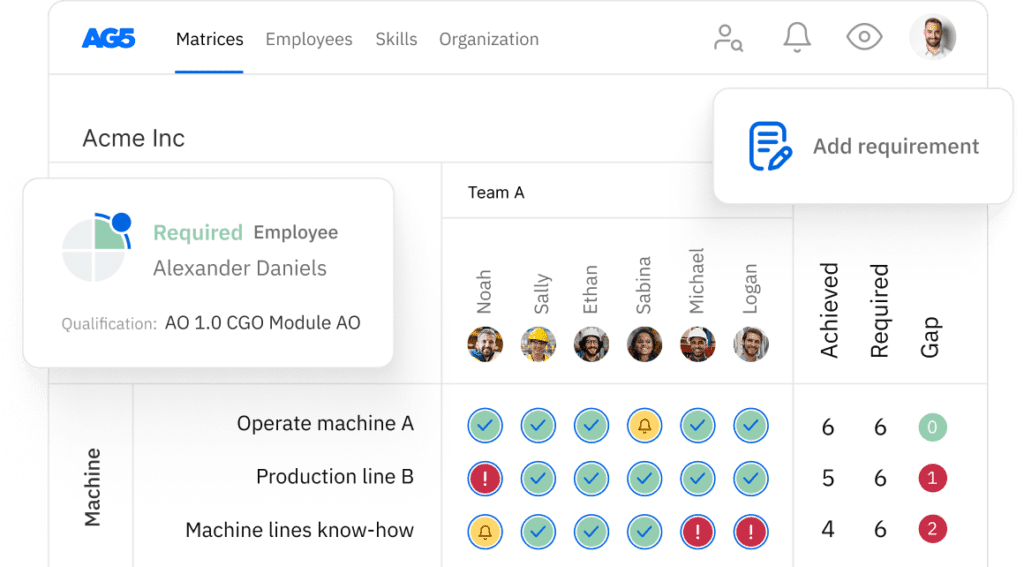
Competency management is the process of defining the skills, knowledge and behaviors required for every role in an organization, assessing employees against those defined targets, and closing any gaps through structured development. It gives the business a single, current view of workforce capability and produces the auditable evidence required by ISO 9001, ISO 45001 and AS9100.
Competency management is the operational backbone of any workforce that has to stay qualified, compliant and productive at the same time. For most HR leaders, L&D managers and operations teams in manufacturing, aerospace, pharma and other regulated industries, it is also the process most likely to collapse under its own weight when it lives in spreadsheets.
This guide covers everything you need, including what competency management actually is, how it differs from skills management, the four types of competencies, how competency models and frameworks work in practice, and a clear sequence for building a program that holds up under audit pressure and at scale.
Table of contentsCopied
What is competency management?Copied
Competency management is the structured, repeatable process that ensures every person in your workforce can do what their role requires, at the level the business needs, on the day they need to do it.
It rests on a simple idea. Every role in your organization requires a defined set of skills, knowledge and behaviors. The business should be able to prove, at any point, who has them and who does not. That sounds straightforward in theory. In practice, organizations managing more than fifty employees across multiple sites, shifts and certification regimes find it almost impossible to maintain in spreadsheets.
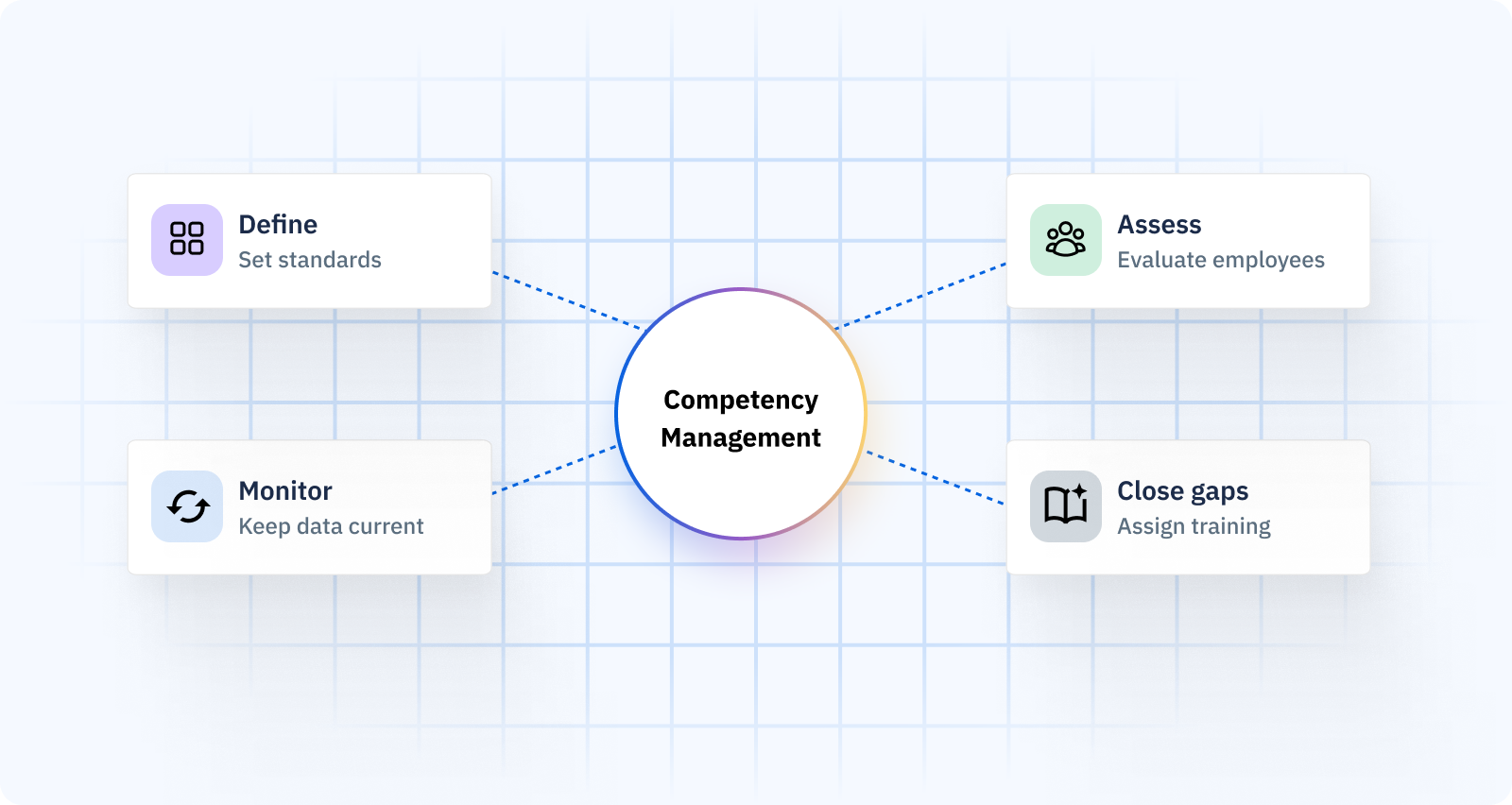
The discipline covers four connected activities.
- Define competencies. What does “good” look like for every role? This becomes your competency framework.
- Assess employees. Where does each person sit against the required standard? This becomes your skills matrix.
- Close gaps. What targeted training will move them up to the required proficiency? This becomes your training matrix.
- Monitor continuously. How do you keep the data current as roles, regulations and people change? This is where the system either holds together or falls apart.
That fourth point is where most organizations struggle. Setting up a framework once is achievable. Keeping it accurate across a workforce of 500 people, 66 skills and three sites 12 months later is not a documentation problem. It is a systems problem.
Why competency management matters: Compliance, capability, riskCopied
For most operational, manufacturing and regulated-industry organizations, competency management is no longer an HR initiative. It is a board-level concern. Three converging pressures make it so.
Compliance is no longer optional. It is enforceable.
ISO 9001, ISO 45001, and AS9100 all require documented evidence that employees are competent to perform their roles. Auditors do not want process diagrams. They want records: signed, dated and tied to the individual. In pharmaceutical manufacturing, GMP compliance requires evidence of trained, qualified personnel for every step of production. In aerospace, AS9100 requires the same. Failure to produce that evidence on the day of an audit can suspend certifications, halt production lines and trigger client contract reviews.
The audit failure scenario is not abstract. Regulators in the EU and US have both taken enforcement action against manufacturers specifically for inadequate competency records. OSHA citations frequently cite the absence of documented training evidence as a contributing factor in workplace incidents. ISO certification bodies have suspended certifications following audit findings tied not to process failures, but to documentation gaps. The competency record is the proof. Without it, compliance is an assumption, not a fact.
Capability is now a strategic risk, not a training line item
Skills volatility is accelerating. The skills required on a 2024 production line are not the skills required on a 2026 production line. Cobotics, predictive maintenance systems, AI-assisted quality control and digital twins are reshaping what “competent” means in real time. Organizations that rely on annual reviews to keep their workforce data current are running on data that is already obsolete by the time it is filed.
Operational risk lives in the gap between what you assume and what you can prove
When a shift supervisor assumes an employee is qualified to operate a piece of equipment, but no current record exists, two things are true at the same time: the equipment may be operated unsafely, and the audit will fail. Competency management closes that gap by replacing assumption with evidence. For executives, it converts a category of operational risk that has historically been invisible into something measurable, manageable and reportable.
For C-suite leaders in manufacturing, pharma, aerospace, automotive, logistics and food and beverage, the question is not whether competency management is necessary. The question is whether the current approach, almost always a combination of spreadsheets and tribal knowledge, is going to hold under the next audit, the next product launch, or the next regulatory inspection.
Skills vs competency: The key differenceCopied
The terms “skill” and “competency” are used interchangeably in everyday business language. They are not the same thing, and the difference has practical consequences for how you build your framework.
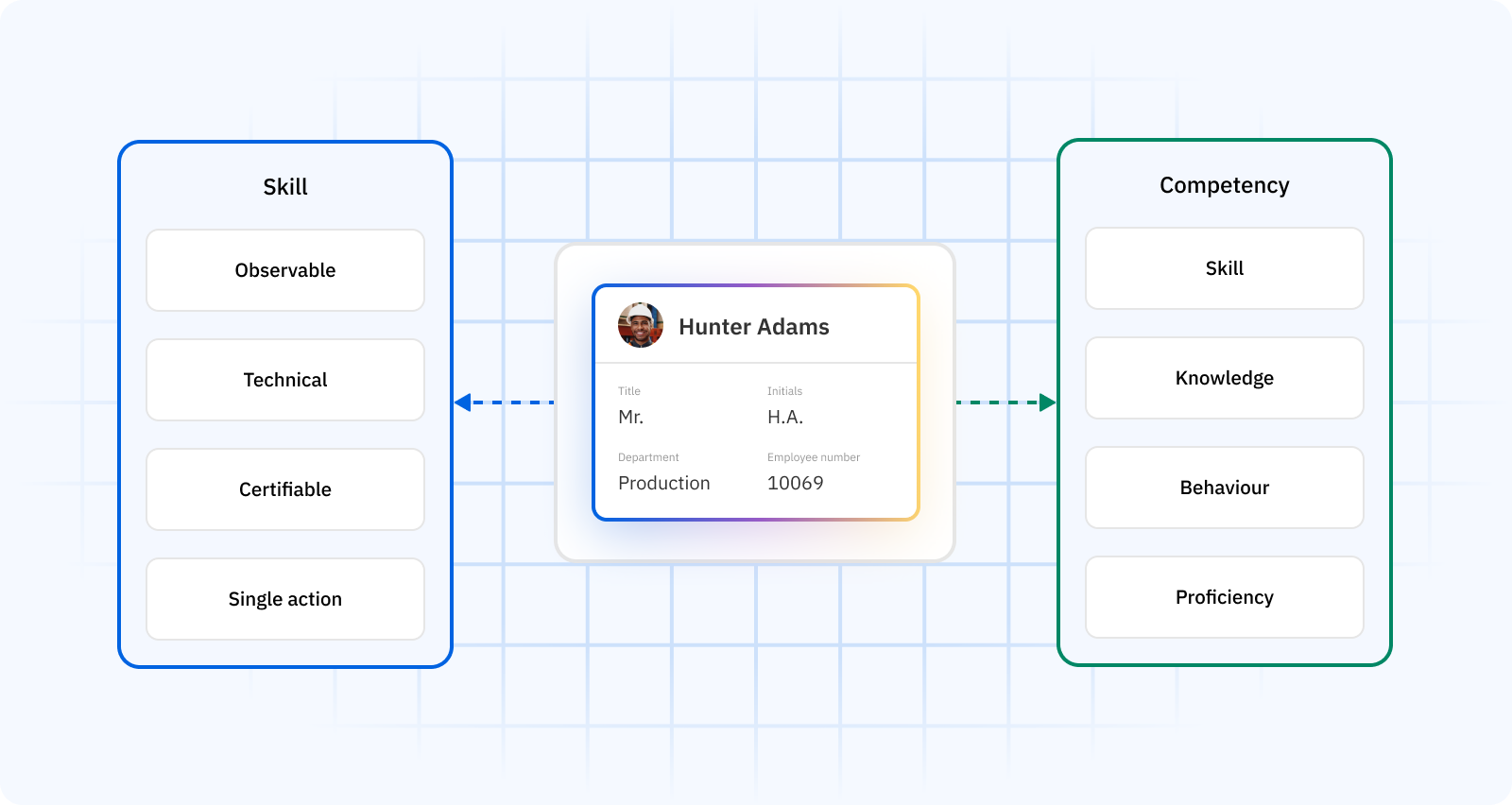
A skill is what someone can do. It is observable, often technical, and frequently certifiable. Welding to AWS D1.1, operating a CNC lathe, performing a glove integrity test, programming a PLC. These are skills.
A competency is broader. It combines the skill itself with the knowledge that informs it, the behavior that surrounds it, and the level of proficiency required for a specific role. A welder is skilled in welding. A competent welder applies that skill safely, to the correct specification, while interpreting drawings, complying with weld procedure specifications, and documenting their work to audit standards.
The distinction matters because a skills matrix answers the question: who can do what? A competency framework answers the question: who is qualified to do what, to the standard the business and the regulator require? Most operational environments need both. The skills matrix is the daily working view. The competency framework is the standard against which the matrix is measured.
For a deeper look at how these two concepts relate in practice, see our guide to skills vs competency.
Types of competenciesCopied
Most competency frameworks group competencies into four categories. The labels vary by industry and by consultant, but the structure is consistent across virtually every well-functioning competency management program. For a full breakdown with examples across industries, see our guide to types of competencies.
1. Core competencies
The skills, knowledge and behaviors every employee needs, regardless of role. Health and safety awareness, communication, basic compliance training. The baseline that applies to every person on the payroll.
2. Functional competencies
The technical and operational competencies tied to a specific job or department. A maintenance technician needs functional competencies in fault diagnosis, lockout-tagout procedure and electrical safety. A quality inspector needs different ones. These sit at the heart of any operational skills matrix.
3. Leadership competencies
Required for anyone with management or supervisory responsibility. People management, performance management, decision-making, conflict resolution. Increasingly, these include data-driven decision-making and the ability to interpret operational dashboards.
4. Behavioral competencies
How the work gets done. Adaptability, accountability, collaboration, ethical judgment. Difficult to assess, but they matter most in fast-changing environments where written procedures cannot cover every situation.
Some frameworks add a fifth category, technical or industry-specific competencies, to capture compliance-driven requirements unique to a regulated industry, such as cleanroom protocol in pharma manufacturing or hot-work certification in oil and gas. Whether you treat these as a separate category or as a sub-set of functional competencies is a structural choice. The important thing is that they are tracked, assessed and renewed on the cycle the regulator requires.
What is a competency model?Copied
A competency model is the structured set of competencies, including required proficiency levels, that defines what successful performance looks like for a specific role, function or organization.
Where a competency framework is the master list across the entire business, a competency model is role-specific. The model for a CNC operator includes the skills, behaviors and proficiency levels required for that role. The model for a production manager includes a different set, with leadership competencies layered on top of functional ones.
A working competency model has three components.
- The competencies themselves, drawn from the framework.
- The required proficiency level for each, defined on a scale, typically 1 to 4 or 1 to 5.
- The evidence requirements: what needs to be observed, tested or certified to confirm the level has been achieved.
Models that exist only on paper rarely survive contact with operational reality. The ones that work are wired directly into the assessment and training workflow, so that every gap against the model triggers an action. For a deeper look at how models are structured and applied, see our guide to competency models.
How competency models differ by industry
The core structure of a competency model is consistent, but the content varies sharply by sector. In aerospace manufacturing, a model for a composite technician will reference AS9100 clauses and specific process certifications as evidence requirements. In pharmaceutical production, a model for a batch record reviewer will reference GMP training records and demonstrated competence in deviation classification. In food and beverage, HACCP awareness and allergen handling will appear as non-negotiable core competencies across almost every operational role.
This sector-specificity is exactly why generic HR competency models rarely survive in regulated, operational environments. The model needs to be built on the actual regulatory and procedural requirements of the business, not on a consultant’s template. That process is more work upfront. It produces far more defensible audit evidence, and far more actionable training decisions, than a model that was designed to be applicable everywhere and is therefore genuinely useful nowhere.
What is a competency framework?Copied
A competency framework is the master document that sets out every competency required across the organization, grouped by category and mapped to roles.
Think of it as the constitution of your competency management program. Every individual assessment, every training assignment and every audit report ultimately traces back to it. If the framework is incomplete, inconsistent or out of date, every downstream process inherits those problems.
A working framework typically contains four elements.
- A defined competency category structure: core, functional, leadership and behavioral.
- A list of individual competencies within each category, with clear definitions.
- Proficiency levels for each, with descriptions of what each level looks like in practice.
- A mapping of which competencies, at what levels, every role requires.
Building a framework from scratch is a significant exercise. For most regulated industries, the sensible approach is to start from an industry-recognized reference set (ISO clauses, ANSI standards, sector-specific frameworks) and adapt rather than invent. The cost of getting this wrong, in audit findings or in training spend that misses the actual gap, is usually far higher than the cost of building it properly the first time. See our step-by-step guide to building a competency framework for a practical walkthrough.
What makes a competency framework fail in practice?
Most framework failures share the same root causes. The framework was designed by HR without input from the people doing the work, so the competency definitions do not match operational reality. The proficiency levels were defined without clear evidence requirements, so assessors apply them inconsistently across sites and managers. The role mapping was done once, at launch, and was never updated as roles evolved or regulations changed.
A framework that starts precise and goes stale is just as dangerous as one that was imprecise from the beginning. The audit trail only holds if the framework reflects the actual current requirements of every assessed role. That means assigning clear ownership of framework maintenance, building in a scheduled review cycle, and connecting the framework to a system that surfaces when roles or regulations have changed in a way that requires an update.
The competency matrix explainedCopied
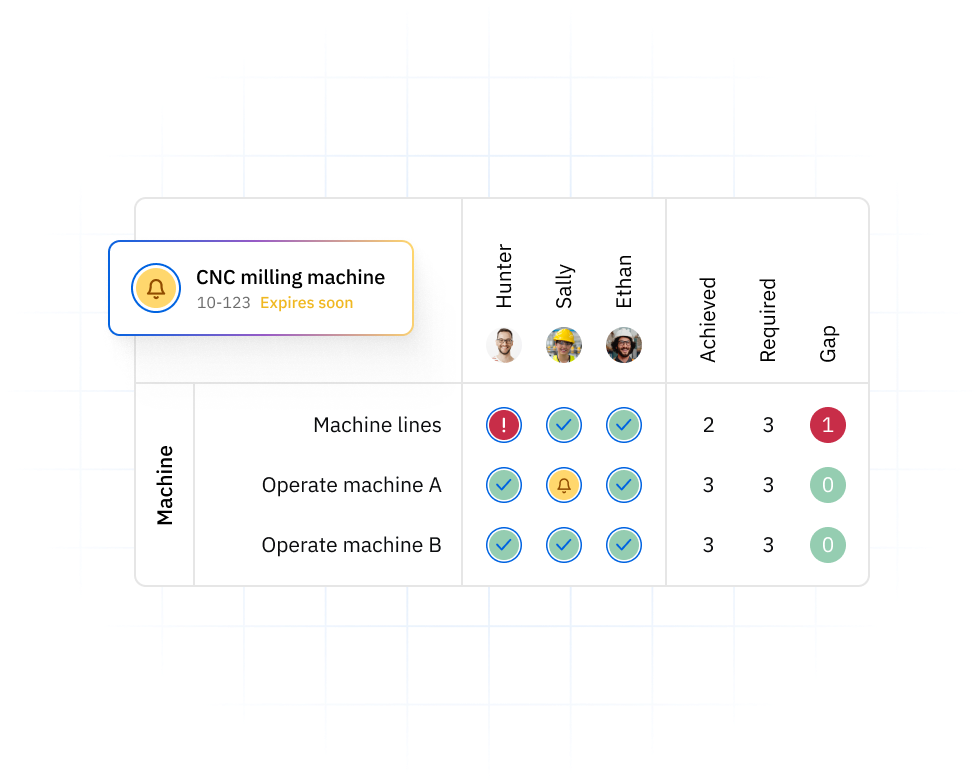
A competency matrix is the operational view of your competency management program. It is a visual grid showing every employee, every relevant competency, and each individual’s current proficiency level.
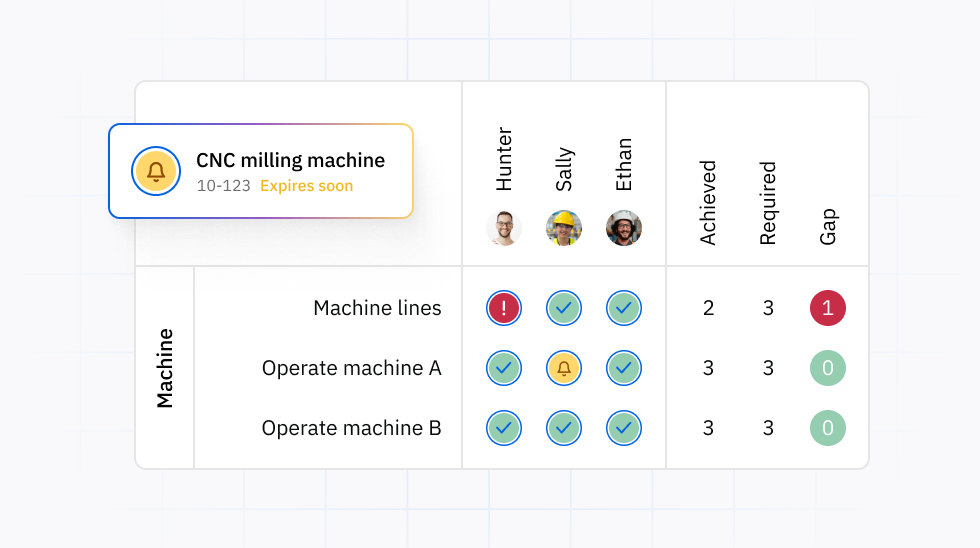
In its simplest form, the matrix shows employees down one axis and competencies across the other, with a color-coded indicator at each intersection. Red for not assessed, amber for in progress, green for fully qualified, often with a numerical level inside.
The competency matrix turns abstract data into operational decisions. A shift supervisor planning Monday’s production can see, at a glance, who is qualified to operate which line. A training coordinator can see, in seconds, where the certification renewals fall in the next sixty days. A quality manager preparing for an ISO audit can produce evidence of competence for any role on the floor without leaving their desk.
The same data in a spreadsheet creates none of these outcomes. The moment the spreadsheet is shared, multiple versions exist, and no one can be certain which one is current. The matrix only works if it is the single, live version of the truth. That is the difference between a competency management system and a managed-by-Excel approach to the same problem.
For a deeper look at how competency matrices are built and used in practice, see our guide to the competency matrix. If you are not yet ready for software, our free skills matrix templates are a useful starting point.
What does a well-functioning competency matrix look like?
A well-functioning competency matrix has three properties that a spreadsheet cannot reliably deliver. It is always current, because the data updates in real time as assessments are completed, certifications expire, and roles change. It is always centralized, because there is one version and every stakeholder reads from the same source. And it is always actionable, because the gaps it surfaces are connected directly to the training assignments and evidence records that close them.
The matrix is also the primary interface between operational management and the competency program. Shift supervisors should not need to request a report from HR to understand the qualification status of their team. They should be able to see it directly, filtered to their team and their relevant competencies, in the system they use every day. When the matrix is accessible at the operational level, it changes behavior. Managers start planning around qualification gaps instead of discovering them during audits.
How to build a competency management programCopied
There is no shortcut to building a competency management program that works. There is, however, a sequence that consistently produces results, and a sequence that consistently does not. Wrong order is what kills most internal projects before they deliver value.
Step 1: Define the scope and the standard
Identify which roles, sites or functions you are starting with. Define what “competent” means for those roles, drawing on regulatory requirements, internal procedures and industry standards. Resist the temptation to design the entire framework on day one.
Step 2: Build the framework
Translate the standard into a working competency framework: categories, competencies, proficiency levels, evidence requirements. Validate it with the people who actua
lly do the work, not just HR.
Step 3: Map roles to the framework
Define which competencies, at which proficiency levels, every in-scope role requires. This becomes the basis of every individual assessment. Our guide to competency mapping covers the practical method in detail.
Step 4: Assess your current workforce
Run a structured assessment of every in-scope employee against the role requirement. Use a mix of manager observation, formal assessment and certification evidence. Record everything in a single, centralized place.
Step 5: Identify and prioritize gaps
Compare current proficiency against required proficiency. Use skill gap analytics to surface the highest-risk gaps first: regulatory, safety-critical, business-continuity-critical.
Step 6: Connect gaps to training
Every gap should map to a defined training intervention. If no intervention exists, design one or buy one. Generic training calendars are the enemy of competency management. The training matrix is the tool that makes this connection traceable.
Step 7: Reassess on a defined cycle
Skills change. Roles evolve. Regulations update. The framework, the role mapping and the individual assessments all need to be reviewed on a regular cycle. For most regulated industries that cycle is annual at minimum, with continuous reassessment for safety-critical or certification-bound competencies.
Step 8: Move from spreadsheets to a system
At any meaningful scale, the difference between a program that delivers measurable outcomes and one that consumes administrative effort without producing them is whether the data lives in a system or in files. The earlier the move, the easier the transition.
How AG5 supports competency managementCopied
AG5 is a dedicated competency management system built for organizations in manufacturing, pharma, aerospace, automotive, logistics and food and beverage. It is designed to replace spreadsheet-based skills tracking with a single, live, audit-ready view of workforce capability.
Here is what AG5 does in practice.
- Visual competency matrix. See every employee’s competence profile across every relevant skill and competency, in real time. Filter by role, team, site, certification or compliance status.
- Real-time gap detection. Gaps are flagged automatically as roles change, certifications expire, or new competencies are added to the framework.
- Audit-ready evidence. Generate ISO 9001, ISO 45001 and AS9100 evidence reports in seconds, not days. Walk into any audit with a complete, time-stamped record of every assessed competency.
- Integrated training assignment. Connect each gap directly to a training intervention, so every development action is evidence-based and traceable.
- AI-assisted skills mapping. Combine and align skills data across departments, sites and acquisitions without manual reconciliation.
- Frontline app. Push relevant competence data, training reminders and approvals to the people on the floor, on the device they already use.
AG5 currently serves more than 200 customers globally, including Tata Steel, Adient, Lenzing, JDE Coffee and Canpack. The product is purpose-built for the operational reality of regulated, multi-site, frontline workforces.
If you are evaluating options, our competency management software comparison sets out how the leading platforms differ.
Ready to replace spreadsheets with a real competency management system? Book a demo to see how AG5 works on your data.
Tired of managing skills in spreadsheets?Copied
AG5 gives you a live, audit-ready view of every employee’s competency profile, across every role, site and certification status without the spreadsheet sprawl. Book a demo to see it on your data, or download our free skills matrix templates to get started today.
FAQs Copied
-
What is a competency management system?
-
What are the four types of competency models?
-
What are the five components of competency?
-
What are the four stages of competency?
-
What is the difference between skills and competencies?
Author Copied

Revisions Copied
Written by: Rick van Echtelt
Copy edited by: Adam Kohut