Learning and Development Strategy: A Practical Guide for 2026
A learning and development strategy is not a training schedule. It is a business case for closing specific skill gaps that block specific business outcomes. This guide covers the six-step framework for building one, why most L&D strategies fail to deliver ROI, and how validated competency data separates strategies that move capability from ones that just run programs.

 Reviewed by Adam Kohut
A learning and development strategy is the difference between a training budget that closes real skill gaps and one that funds activity with no measurable outcome. Most organizations run training. However, far fewer can show that it actually moved the needle on workforce capability.
This guide covers what an L&D strategy actually is, why most fail to deliver ROI, and how to build one grounded in validated skills data. In addition, it includes a step-by-step framework, industry examples, and the measurement approach that separates strategies that work from ones that just run programs. If your organization is starting from a skills gap analysis, this is the logical next step.
What is learning and development (L&D)?Copied
Learning and development (L&D) is the organizational function that builds employee capability through training, coaching, mentoring, and structured learning experiences to meet current and future business needs.
L&D sits at the intersection of HR and business strategy. At its most effective, it is not a training catalog or a compliance calendar. Instead, it is the mechanism that connects what the business needs its people to become with structured programs that move them there.
The “and development” distinction matters. To clarify, learning is the acquisition of knowledge or a skill. By contrast, development is the sustained application and deepening of that capability over time. As a result, an L&D strategy must address both.
What is an L&D strategy?Copied
An L&D strategy is a planned, evidence-based approach for building the workforce capabilities an organization needs to achieve its goals. In practice, it connects skills gap analysis, program design, delivery, and measurement into a coherent system that leaders can evaluate and improve.
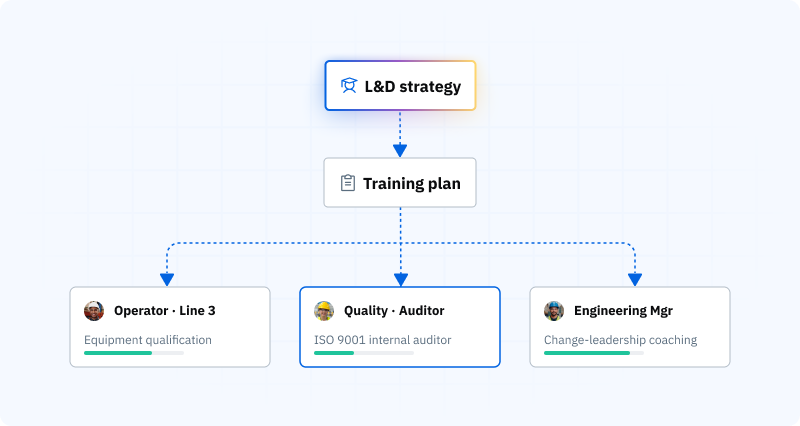
A training plan lists what learning activities are running, when, and for whom. By contrast, an L&D strategy explains why: which capability gaps it closes, what business objectives that serves, how the team measures success, and what investment makes sense.
In short, a training plan is a schedule. An L&D strategy, on the other hand, is a business case that happens to include a schedule.
L&D strategy vs. training plan vs. L&D planCopied
| Term | What it is | Primary output | Primary owner |
|---|---|---|---|
| L&D strategy | Evidence-based framework defining which capabilities to build, why, how, and how to measure success | Strategic document connecting L&D investment to business outcomes | CLO, HR leadership |
| Training plan | Operational schedule of learning activities — who, what, when | Training calendar and completion tracking | L&D managers, training coordinators |
| L&D plan (individual) | Employee’s personal learning and development goals, also called an employee development plan | Personal development goals and activities | Manager + employee |
| Corporate learning strategy | How learning investment aligns with corporate goals | Learning investment priorities and governance | Executive team + HR |
An L&D strategy without a training plan has no operational reality. Equally, a training plan without an L&D strategy is just activities without a purpose.
Why most L&D strategies don’t deliver ROICopied
McKinsey research shows that organizations linking L&D to business strategy are significantly more likely to be top financial performers. Almost every L&D article cites this finding. However, the question nobody answers is: why don’t more organizations achieve it?
In practice, there are three consistent failure modes.
Failure mode 1: Built on the wrong data
An L&D strategy is only as good as the skills gap analysis underneath it. Unfortunately, the skills gap analysis in most organizations is just a manager survey, a self-assessment exercise, or a top-down assumption about what “the business needs” this year.
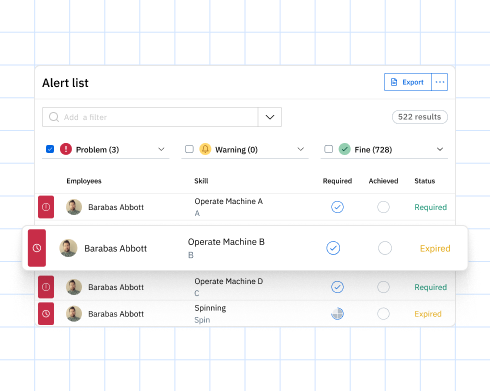
These inputs produce L&D strategies that target the wrong gaps. Training programs run. Completion data flows in. However, almost no one measures whether the underlying capability gap actually closed. As a result, the same skills gaps reappear in next year’s L&D strategy, because last year’s program didn’t close them — or closed the wrong ones.
The organizations that build L&D strategies that actually move capability start with validated competency data: manager-assessed, evidence-based, current. In other words, not “what do employees think they need?” but “what does the skills data show is missing against the role requirements?”
Failure mode 2: Completion as the proxy for effectiveness
Most teams measure L&D programs on completion rates. Who attended. Who passed the assessment. What percentage of the team finished the module. Unfortunately, these metrics measure activity, not outcome.
The question a business leader should ask — and rarely does — is: “Are the people who completed this program more capable of doing their jobs than they were before?” To answer that, the team needs a competency re-assessment after the program, not just a sign-off that the trainer delivered the content.
Failure mode 3: Strategy that doesn’t connect to how work is actually done
The line manager who needs someone competent for a production run on Thursday morning does not care about the enterprise learning framework. Likewise, the frontline supervisor who needs to know who is qualified before a shift starts is not working from an L&D strategy document.
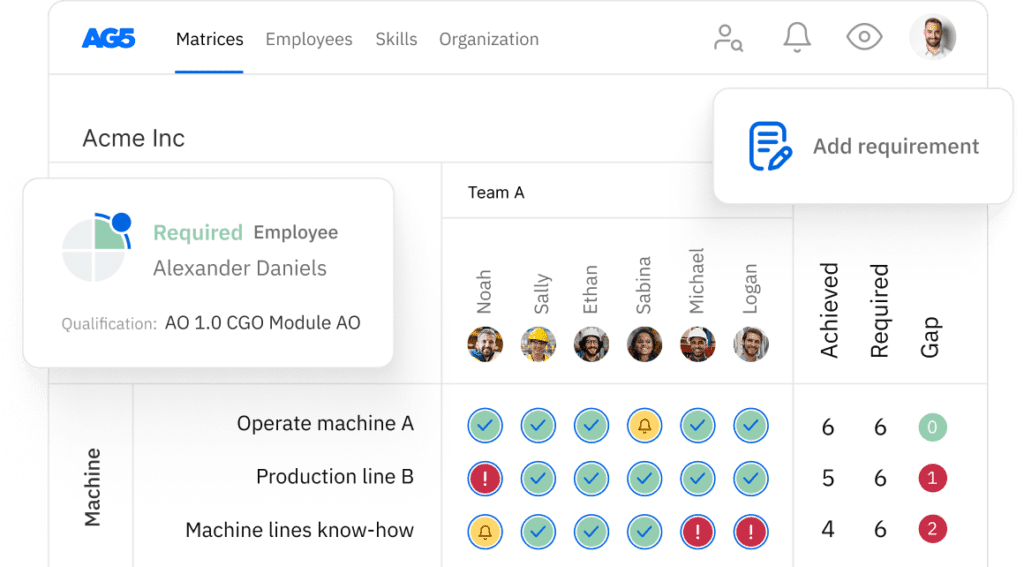
An effective L&D strategy has to connect to operational reality. That means the people making real-time deployment decisions must be able to see the skills data and training records, not just the L&D team building quarterly reports. For this reason, a training matrix is the operational tool that bridges the gap between strategy and the shop floor.
The essential components of an L&D strategyCopied
1. Skills gap analysis – The evidence base
The foundation of every L&D strategy is a current, accurate picture of the gap between what the workforce can do now and what the business needs it to do next. This means a validated competency assessment: managers assess proficiency against defined criteria, supported by evidence. Without this foundation, every other component rests on assumption.
2. Business alignment – Translating strategy into capability requirements
What is the organization trying to achieve in the next 12 to 36 months? And what does that require from its workforce? This is the most important and most commonly skipped step. As a result, most L&D strategies start with learning activities rather than business objectives.
3. Prioritized interventions – Targeted, not comprehensive
Not all skill gaps carry equal business consequence. Therefore, prioritization should follow risk (which gaps create safety or compliance risk?), business impact (which gaps most limit strategic execution?), and achievability (what can the team realistically close in the plan period?).
4. Delivery design – Matching modality to gap type
Different gaps require different interventions:
- Knowledge gaps respond to structured learning: eLearning, classroom training, self-directed study.
- Skill gaps require practice under observation: stretch assignments, coaching, simulated environments.
- Certification and compliance gaps require formal qualified programs with assessed evidence.
- Behavioral and leadership gaps respond best to coaching, mentoring, and structured feedback over time.
5. Measurement framework – Tracking capability change, not course completion
The measurement framework requires four things: a baseline competency assessment before the intervention, a defined target proficiency level, a post-intervention re-assessment, and a clear feedback loop. In other words, completion data tells you the activity happened. Competency change, on the other hand, tells you whether the investment actually produced capability.
6. Governance and continuous improvement
L&D strategies go stale. Roles evolve. Technology changes which skills matter. New compliance requirements emerge. For these reasons, a governance process that reviews the strategy at least annually — with quarterly check-ins on key metrics — keeps it connected to current business reality.
How to build an L&D strategy in 6 stepsCopied
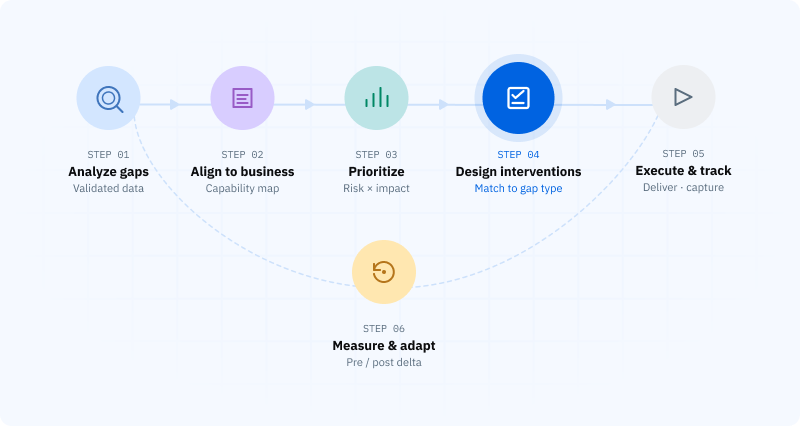
Step 1: Conduct a skills gap analysis
Map what the workforce currently has against what the business currently requires and will require. To do this, use validated competency data: manager-assessed, supported by evidence, current. This is the input that separates a strategy from a list of popular training topics.
Step 2: Align to business objectives
Translate the 12 to 36 month business plan into specific capability requirements. For each strategic objective, identify the competencies that enable it. Then, for each competency, compare the required level against the skills gap data. Ultimately, the intersection — gaps in business-critical competencies — becomes your L&D priority list.
Step 3: Prioritize by risk and impact
Rank by compliance risk (will this gap create regulatory exposure?), safety risk (does this gap create physical danger?), and strategic impact (does this gap block a major business initiative?). Then, address the highest-consequence gaps first.
Step 4: Design targeted interventions
For each prioritized gap, design an intervention matched to the gap type: knowledge, skill, certification, or behavioral. In each case, specify delivery modality, provider, timeline, and the assessment approach that will confirm the gap has closed.
Step 5: Execute and track
Deliver the interventions. Track completions as operational data — not as the primary success metric. Then, conduct post-intervention competency re-assessments. Update skills records as competency develops.
Step 6: Measure, review, and adapt
At each governance checkpoint, compare pre and post competency data. Which gaps closed? Which didn’t? Where did the team find misalignment between intervention design and gap type? This is the continuous improvement loop that separates a living L&D strategy from an annual training refresh.
L&D strategy examplesCopied
Manufacturing: ISO compliance and production capability
Business objective: Expand to a third production line and achieve ISO 9001 certification for the new site by Q4.
Capability requirement: All operators on Line 3 qualified for new equipment procedures and ISO 9001 Clause 7.2 documentation requirements. In addition, quality managers must be able to conduct internal audits independently.
L&D interventions: First, an equipment qualification program for Line 3 operators (assessed, with supervisor sign-off required). Next, ISO 9001 Internal Auditor qualification for the quality team (external provider). Finally, SOP familiarization and sign-off for all affected roles.
Success measured by: A competency re-assessment showing all operators at the required proficiency level. The lead auditor then signs off internal audit capability. Ultimately, the team achieves ISO 9001 certification on schedule.
Healthcare: mandatory training compliance and clinical capability
Business objective: Achieve a CQC compliance rating and reduce the clinical incident rate by 15%.
Capability requirement: All clinical staff current on mandatory training. In addition, the team needs to close competency gaps in medication administration and infection control.
L&D interventions: First, an automated expiry tracking and renewal program for all mandatory certifications. Next, targeted clinical skills coaching for staff below the proficiency threshold. Finally, simulation-based training for high-risk procedures.
Success measured by: Zero lapsed mandatory certifications at the next CQC inspection. Additionally, post-intervention competency re-assessment shows improvement in targeted clinical competencies.
Technology company: Digital transformation capability
Business objective: Migrate all legacy infrastructure to cloud by end of year.
Capability requirement: DevOps and infrastructure teams capable of managing cloud-native environments. In parallel, managers need to lead the change effectively.
L&D interventions: First, a cloud certification program for the infrastructure team (AWS/Azure — externally certified). Next, a leadership development program for engineering managers (coaching-based, 6-month program). Finally, an internal knowledge transfer program pairing cloud-experienced engineers with the legacy team.
Success measured by: Cloud certification achieved across all infrastructure team members. Manager competency re-assessment then shows improvement in change leadership. Ultimately, the team delivers the migration on schedule.
Free L&D strategy templateCopied
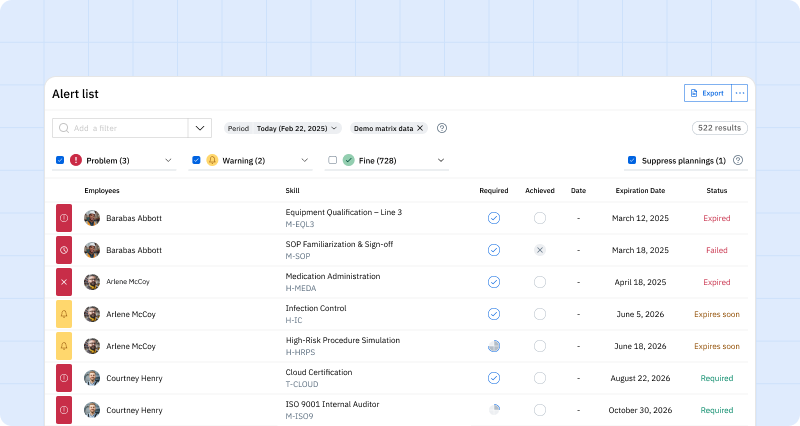
A complete L&D strategy template should cover: a skills gap analysis summary, business objectives mapped to capability requirements, intervention designs for each priority gap, a measurement framework, an investment summary, and a governance schedule.
The missing layer: Connecting L&D strategy to real skills dataCopied
Every L&D strategy eventually confronts the same question: are we investing in closing the right gaps?
Most organizations can’t answer it. They can tell you what programs ran, who attended, and what scores people achieved. However, they cannot tell you whether the workforce is more capable at the things that matter than it was 12 months ago.
The reason is structural. Most teams build L&D strategies on assumed skill gaps — manager opinions, self-assessments, and last year’s priorities — rather than on validated competency data that reflects where the workforce actually sits against role requirements right now. For this reason, effective competency management is what turns that assumption into evidence.
AG5 provides the validated skills data layer that makes L&D strategy evidence-based rather than assumption-based:
- Continuous competency tracking: managers assess skills against defined frameworks, validate them, and the system updates records when an employee completes training.
- Gap analytics: a real-time view of where the workforce sits against required competency levels, filterable by role, team, and site.
- Training completion integration: LMS completions automatically update competency records, which then triggers post-training re-assessment workflows.
- Measurement infrastructure: before and after competency data that shows whether L&D investment moved the needle.
An L&D strategy built on AG5 data starts from a reliable baseline, directs investment at measured gaps rather than assumed ones, and produces evidence of whether the strategy worked — not just whether the training ran.
Build L&D strategy on skills data you can actually trustCopied
AG5 gives L&D and operations teams validated, real-time competency data, so you can direct training investment at measured gaps, not assumed ones. Book a free demo to see how it works, or download free L&D strategy templates to get started today.
FAQs Copied
-
What is learning and development (L&D)?
-
What is an L&D strategy?
-
What is the difference between an L&D strategy and a training plan?
-
Why is learning and development important?
-
What is an enterprise learning framework?
-
How do you align L&D strategy with business strategy?
-
How do you measure the ROI of an L&D strategy?
-
What should an L&D strategy template include?
Author Copied

Revisions Copied
Written by: Rick van Echtelt
Copy edited by: Adam Kohut