The strategic guide to upskilling employees and closing the skills gap
In a world where 72% of Chief Human Resources Officers expect artificial intelligence to fundamentally shift job roles within just three years, according to Gallup research, one truth has become undeniable: the skills that got your team here won’t be enough to keep them competitive tomorrow. Upskilling employees, the strategic process of enhancing your workforce’s existing capabilities to meet evolving...

 Reviewed by Adam Kohut
In a world where 72% of Chief Human Resources Officers expect artificial intelligence to fundamentally shift job roles within just three years, according to Gallup research, one truth has become undeniable: the skills that got your team here won’t be enough to keep them competitive tomorrow.
Upskilling employees, the strategic process of enhancing your workforce’s existing capabilities to meet evolving business demands, is no longer a nice-to-have HR initiative; it’s a survival imperative.
The traditional approach of hiring externally to fill skills gaps is becoming increasingly unsustainable. The average time-to-hire has stretched beyond 40 days in many industries, and the cost of replacing an employee now exceeds twice their annual salary. Meanwhile, the “skills gap”, once discussed as a looming future challenge, has arrived as a present-day crisis affecting organizations across every sector.
But here’s the good news: forward-thinking organizations are discovering that the solution isn’t outside their walls, it’s already sitting at their desks, attending their meetings, and waiting for the opportunity to grow.
This comprehensive guide explores the strategic framework for upskilling employees effectively. We’ll cover the meaning and benefits of upskilling, introduce you to the proven 70-20-10 rule for training, examine how AI is transforming employee development, and provide you with a concrete implementation plan that includes skills gap analysis and practical next steps. Whether you’re an HR leader, L&D professional, C-suite executive, or department manager, you’ll walk away with actionable strategies to build a resilient, future-ready workforce.
What is the meaning of upskilling employees?Copied
At its core, upskilling is the deliberate process of enhancing an employee’s existing skill set to help them advance along their current career trajectory. It’s about taking someone who’s good at their job and giving them the tools, knowledge, and capabilities to become exceptional, or to adapt as their role evolves with market demands.
Upskilling vs. reskilling: Understanding the difference
While these terms are often used interchangeably, they serve distinct purposes in your employee development strategy:
Upskilling focuses on deepening and expanding skills within a current role or career path. Think of a graphic designer learning advanced 3D modeling techniques, a sales representative mastering data analytics to better understand customer behavior, or a software developer adding cloud architecture expertise to their existing programming knowledge. The employee stays on their current career track but becomes more proficient and valuable.
Reskilling, on the other hand, involves training employees in entirely new skill sets to transition them into different roles. This might look like an administrative assistant moving into a junior project management position, or a customer service representative transitioning to a data analyst role. Reskilling is about creating new career pathways when roles become obsolete or when business needs shift dramatically.
Beyond one-time training events
The most successful organizations understand that upskilling isn’t a checkbox exercise or an annual training event. It’s about cultivating a genuine learning culture where continuous growth becomes woven into the fabric of daily work. In this environment, employees don’t just attend workshops, they actively seek out stretch assignments, share knowledge with colleagues, and view every challenge as an opportunity to expand their capabilities.
When done right, upskilling transforms your organization from a place where people simply work into a place where people grow.
Why is upskilling important? Copied
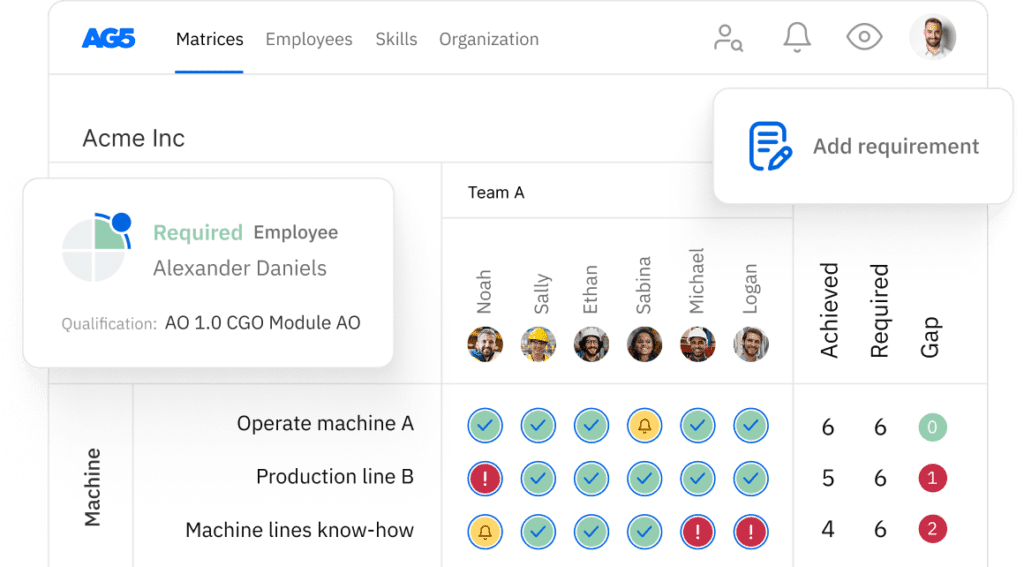
The business case for strategic upskilling extends far beyond feel-good employee development rhetoric. The data reveals concrete, bottom-line benefits that directly impact organizational success. Understanding and tracking workforce skills is fundamental to realizing these benefits.
Employee retention: Your secret weapon in the talent war
LinkedIn’s research reveals a striking statistic: 94% of employees say they would stay at a company longer if it invested in their career development. In an era where employee turnover continues to challenge organizations, upskilling represents one of the most effective retention tools available.
When employees see a clear path forward, when they know their employer is invested in their future, they become naturally more committed to the organization. They’re not constantly scanning job boards or taking recruiter calls because they’re engaged in their own growth story, one that’s unfolding right where they are.
Cost efficiency: The math is undeniable
Let’s talk numbers. Replacing a single employee typically costs between 1.5 to 2 times their annual salary when you factor in recruitment expenses, onboarding time, lost productivity, and the inevitable learning curve. For a $60,000 employee, that’s a $90,000 to $120,000 investment just to get back to square one.
Upskilling, by contrast, costs a fraction of that amount. Even comprehensive training programs, mentorship initiatives, and certification courses pale in comparison to the revolving door of talent acquisition. The return on investment becomes even more compelling when you consider that upskilled employees often perform at higher levels than new hires who are still getting up to speed.
Future-proofing: Building organizational resilience
Organizations that prioritize continuous learning and maintain a growth mindset are three times more likely to successfully navigate digital transformations and industry disruptions. This isn’t surprising when you consider that upskilled workforces are inherently more adaptable.
When change arrives, and it always does, teams that are accustomed to learning new skills don’t panic or resist. They adapt. They’ve already developed the meta-skill of learning itself, which becomes increasingly valuable as the pace of technological change accelerates.
Improved morale: The psychological impact of investment
There’s a profound psychological shift that occurs when employees realize their organization sees them as worth investing in. When career pathways are clearly defined and internal mobility becomes a realistic possibility, engagement naturally increases.
Employees who feel valued and recognized don’t just work harder, they bring more creativity, take more initiative, and contribute more fully to organizational success. They become advocates for your company culture, your products, and your mission. The intangible benefits of improved morale ripple throughout the organization in ways that are difficult to measure but impossible to ignore.
What is the 70-20-10 rule for training?Copied
One of the most valuable frameworks for designing effective upskilling programs is the 70-20-10 model, a research-backed approach that optimizes how people actually learn and retain new skills.
The framework breakdown
The 70-20-10 rule suggests that impactful employee development should follow this ratio:
70% Experiential learning (Job-based)
The overwhelming majority of skill development happens through hands-on experience and real-world application. This includes:
- Stretch assignments that push employees slightly beyond their comfort zone
- Real projects with actual business impact and accountability
- On-the-job problem-solving where employees must figure things out
- Rotational opportunities that expose them to different aspects of the business
- Leading initiatives or small teams to develop leadership capabilities
This is learning by doing, the most powerful form of skill development. When employees tackle genuine challenges with real stakes, they learn faster and retain knowledge longer than any classroom setting can provide.
20% Social learning (Relationship-based)
The second component focuses on learning through others:
- Structured mentorship programs pairing junior employees with experienced professionals
- Coaching sessions that provide personalized feedback and guidance
- Peer-to-peer learning groups where colleagues share insights and best practices
- Collaborative projects that force knowledge transfer
- 360-degree feedback sessions that provide multiple perspectives on performance
Social learning recognizes that we often learn best through observation, conversation, and feedback from others who have already walked the path we’re on.
10% Formal learning (Education-based)
The smallest slice, but still important, involves structured educational experiences:
- Classroom training and workshops
- Online courses and certifications
- Industry conferences and seminars
- Reading assignments and research
- Webinars and formal presentations
The critical insight most organizations miss
Here’s the uncomfortable truth: most organizations invert this model entirely. They pour 80-90% of their training budget into formal education, the 10% slice, while largely neglecting the experiential and social components that actually drive skill development.
The classroom has its place, but it’s most effective as a supplement to hands-on experience and peer learning, not as a replacement for them. High-impact upskilling strategies deliberately prioritize the 70% and 20% components, using formal education as a foundation rather than the entire structure.
When you design your employee development strategy around this principle, you create learning experiences that stick, skills that transfer to actual work, and employees who can immediately apply what they’ve learned to drive business results.
AI and upskilling: The modern acceleratorCopied
Artificial intelligence has emerged as both the reason organizations need to upskill urgently and the tool that makes effective upskilling more achievable than ever before. Understanding both dimensions is critical for modern HR and L&D strategies.
Upskilling for AI: Building AI literacy across your organization
The first imperative is preparing your workforce to work effectively alongside AI technologies. This involves:
AI literacy training. Ensuring employees understand what AI can and cannot do, how it makes decisions, and where human judgment remains essential. This foundational knowledge helps teams move past fear and toward productive collaboration with AI tools.
Prompt engineering. As AI assistants become commonplace in knowledge work, the ability to communicate effectively with these tools, crafting clear prompts and interpreting results critically, becomes a valuable skill across functions.
Ethical AI usage. Training employees to recognize bias, understand data privacy implications, and use AI responsibly ensures your organization avoids the pitfalls that come with powerful new technologies.
The mindset shift is crucial. Organizations that frame AI as a threat create resistance and fear. Those that position AI as a co-pilot, a tool that augments human capabilities rather than replacing them, unlock enthusiasm and innovation.
Upskilling with AI: Leveraging technology to accelerate development
The second dimension is using AI itself as a learning accelerator:
Adaptive learning platforms. AI-powered training systems can personalize content delivery based on an individual’s learning speed, prior knowledge, and preferred learning style. If someone is struggling with a concept, the system provides additional examples and exercises. If they’re excelling, it accelerates their progression. This individualization was impossible at scale before AI
Simulated coaching and practice. AI chatbots can now facilitate realistic role-playing scenarios for skills like sales conversations, difficult feedback discussions, or customer service interactions. Employees can practice repeatedly in a low-stakes environment, receiving immediate feedback on their approach. This addresses the traditional challenge that coaching is expensive and doesn’t scale well
Predictive analytics. Perhaps most powerfully, AI can analyze workforce data, industry trends, and business strategy to predict where skills gaps will emerge before they become critical. This allows organizations to be proactive rather than reactive, upskilling employees for roles and responsibilities that don’t quite exist yet but will soon be essential
Real-time performance support. AI assistants can provide just-in-time guidance when employees encounter new situations, essentially serving as an always-available mentor that helps them work through challenges they haven’t been formally trained on
The organizations that will win the talent war are those that embrace both dimensions: preparing their people for an AI-augmented future while simultaneously using AI to make that preparation more effective, personalized, and scalable.
How do you upskill employees? Copied
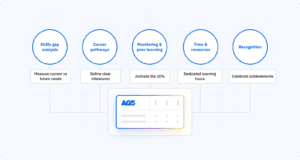
Strategic upskilling requires more than good intentions, it demands a systematic approach. Here’s a practical, five-step framework for implementing an effective upskilling program in your organization.
Step 1: Conduct a comprehensive skills gap analysis
You cannot close a gap you haven’t measured. Start by auditing your current workforce capabilities against future needs:
- Assess current skills. Document what competencies your team possesses today across all roles and levels
- Identify future requirements. Work with leadership to understand business strategy and translate it into required skills 18-24 months out
- Map the gaps. Create a clear picture of the delta between current capabilities and future needs
- Prioritize criticality. Not all skills gaps are equally urgent. Focus on those that will most impact business outcomes
This analysis should involve multiple stakeholders, department managers who understand day-to-day work, executives who grasp strategic direction, and employees themselves who often have keen insights into where they need support.
Tools like skills matrices, competency assessments, and performance data can provide objective insights, but don’t underestimate the value of qualitative conversations. Sometimes the most important gaps are the ones people feel but haven’t articulated. For a comprehensive approach to conducting this analysis, explore our detailed guide on how to conduct a skills gap analysis.
Step 2: Define clear career pathways and development milestones
Employees need to see the roadmap. Ambiguity around how to advance creates frustration and disengagement. For each major role in your organization, clearly define:
- Current state requirements/ What does proficiency look like at this level?
- Next level expectations/ What specific skills, experiences, and competencies are required to advance?
- Milestone achievements/ What are the observable, measurable markers of progression?
- Timeline estimates/ How long does this typically take, and what factors accelerate or slow progress?
Make these pathways visible and accessible. Publish them on your intranet, discuss them in one-on-ones, reference them in performance reviews. When a junior analyst can see exactly what technical skills, leadership experiences, and project outcomes will help them become a senior analyst, they can take ownership of their development journey. Learn more about structuring these frameworks through competency mapping.
This transparency also helps managers become better coaches. Instead of vague encouragement to “keep doing great work,” they can provide specific, actionable guidance: “To move to the next level, you need to lead a cross-functional project and develop proficiency in data visualization tools.”
Step 3: Integrate structured mentoring and peer learning
Remember the 20% of the 70-20-10 rule? This is where you activate it systematically:
- Formal mentorship programs. Pair employees with more experienced colleagues who can provide guidance, share insights, and help navigate organizational dynamics
- Peer learning circles. Create small groups of employees at similar levels who meet regularly to share challenges, solutions, and learning
- Reverse mentoring. Don’t overlook the value of junior employees mentoring senior leaders on emerging technologies and trends
- Internal speaker series. Highlight internal expertise by having employees present on their areas of mastery
- Shadowing opportunities. Allow employees to observe colleagues in different roles or departments
The key is structure. Without deliberate design, these relationships rarely form naturally, especially in remote or hybrid environments. Create the frameworks, provide the meeting templates, and hold people accountable to participating.
Step 4: Provide dedicated time and necessary resources
Here’s a reality check from Gallup research: 65% of employees prefer training during normal working hours. Yet many organizations expect employees to upskill during evenings, weekends, or by somehow “finding time” in their already packed schedules.
This approach virtually guarantees that only the most motivated (or least busy) employees will participate, creating inadvertent inequities in development opportunities.
Instead, build learning time into the work week:
- Allocate specific hours. Give employees protected time for development activities, whether it’s 10% of their week or designated “learning Fridays”
- Budget for training. Provide financial resources for courses, certifications, conferences, and books
- Invest in platforms. High-quality learning management systems and course libraries make self-directed learning more accessible
- Support participation. Make it culturally acceptable, even encouraged, to block calendar time for development
When learning is positioned as equally important as other work (rather than something to squeeze in around “real” work), employees take it seriously and engagement increases dramatically. Effective workforce planning requires this kind of systematic resource allocation.
Step 5: Recognize progress and celebrate achievements
The behaviors you reward are the behaviors you get more of. Make skill development visible and valued:
- Public recognition. Celebrate when employees earn certifications, complete major programs, or demonstrate new competencies
- Incorporation into reviews. Include learning objectives in performance evaluations and advancement decisions
- Internal communications. Share success stories in company newsletters, all-hands meetings, and team updates
- Tangible rewards. Consider bonuses, promotions, or special projects for employees who invest significantly in their development
- Create advocates. Encourage upskilled employees to share their learning journey with colleagues
Recognition serves two purposes: it rewards the individual while simultaneously signalling to the entire organization that skill development matters. When people see their colleagues being celebrated for growth, they become more likely to pursue their own development.
The win-win reality of strategic upskillingCopied
At its heart, upskilling represents one of the rare business strategies where everyone truly wins. The employee gains increased market value, expanded capabilities, and greater career security. The employer gains a more resilient, loyal, and capable workforce that can adapt to whatever challenges tomorrow brings.
In an era of rapid technological change, global competition, and evolving customer expectations, the organizations that will thrive are those that view their people not as fixed resources but as dynamic assets capable of continuous growth.
The skills gap is real, and it’s growing. But the solution isn’t to constantly look outside your organization for talent that may not even exist in the market yet. The solution is to systematically, strategically, and empathetically develop the incredible potential that already exists within your walls.
The question isn’t whether you can afford to invest in upskilling. The question is whether you can afford not to.
Ready to close your skills gap?Copied
Is your team prepared for the future of work? The time to act is now, before the skills gap widens further and your competitors gain an insurmountable advantage.
Start your journey with these concrete next steps:
- Conduct your skills gap analysis and audit current capabilities against future needs
- Download our comprehensive guide to implementing the 70-20-10 training framework
- Schedule a workshop with your leadership team to define clear career pathways
- Launch a pilot program in one department before scaling organization-wide
The workforce of tomorrow isn’t out there waiting to be hired. They’re already here, at your company, waiting for you to invest in their potential. Give them that opportunity, and watch your organization transform.
FAQs Copied
-
What's the difference between upskilling and reskilling?
-
How much should companies invest in employee upskilling?
-
What is the 70-20-10 rule in employee training?
-
How does AI impact employee upskilling strategies?
-
How do you measure the success of an upskilling program?
-
What are the biggest obstacles to effective employee upskilling?
-
How can small businesses implement upskilling with limited budgets?
Author Copied

Revisions Copied
Written by: Rick van Echtelt
Copy edited by: Adam Kohut