HR system integration for skills management: What data moves
The five fields that carry an HR integration, the two that should never move, and the step where these projects break.

 Reviewed by Adam Kohut
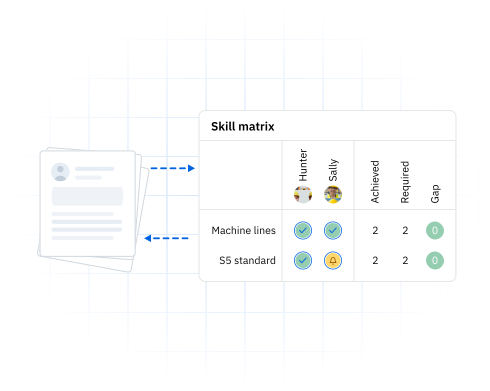
An operator transfers from the Cincinnati plant to Louisville on a Monday. HR updates Workday that morning. If the skills system does not hear about it, Louisville’s roster still shows her as unqualified for everything. Cincinnati’s compliance figure is still counting her. The transfer paperwork has created two wrong numbers before lunch.
Integration between the HR system and the skills management system exists to stop that. This guide covers what actually moves between the two, in which direction, how often, and the handful of things that decide whether the integration holds up when someone audits it.
HRIS or skills management system: Which owns what?Copied
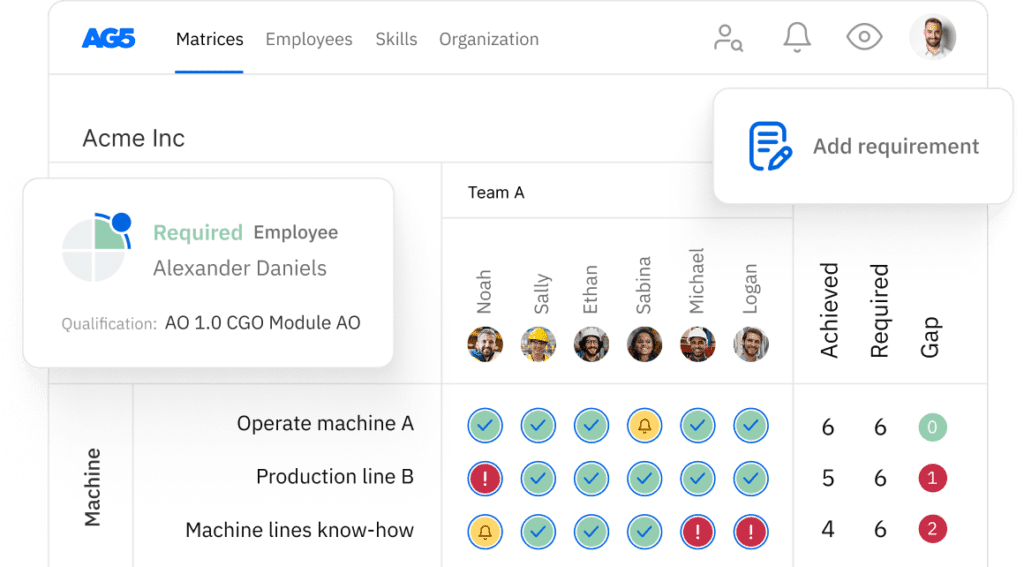
The HRIS is the source of truth for the person: identity, employment status, role, site, manager, start and end dates. Workday, SAP SuccessFactors, ADP, Dayforce and BambooHR all sit here.
The skills management system is the source of truth for the qualification: what the person is trained, assessed and authorized to do, against which requirement, with what evidence and what expiry. The LMS sits alongside both as the source of truth for course completion, and completion is not qualification.
The definitions are in LMS, TMS, KMS, HRM and CMS: what’s the difference. The argument about which system should own the training requirement is in choosing a training management system.
Integration is what lets each system stay authoritative for its own data without anyone re-keying it into the other two. Get the ownership wrong and the integration does not fix the problem. It copies the errors faster.
What moves from HR to the skills system?Copied
Five fields do almost all of the work. Everything else is optional, and two commonly requested fields should be refused outright.
- Employee identifier. A stable ID that survives name changes, rehires and contractor conversions. Email addresses and names are not identifiers.
- Employment status and dates. Start date creates the record. End date archives it. Leave status pauses expiry alerts without archiving, which matters more than it sounds during a long absence.
- Role or job code. This is the trigger for requirements. When the role changes, the required qualifications change with it, and the gap should appear the same day.
- Site, department, team, cost center. Requirements are layered by these, and so are dashboards and audit exports.
- Manager. Determines who approves sign-offs and who receives expiry notifications.
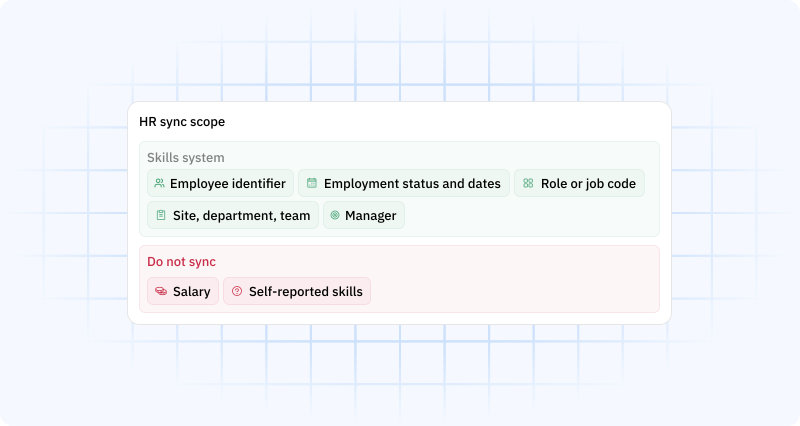
Two things HR usually wants to send should not go. Salary is irrelevant to qualification and is a data protection liability in a system that supervisors and team leads can see. Free-text profile skills are self-reported and unassessed. Mix them into a compliance record and the matrix starts claiming things an auditor can disprove on the floor in five minutes.
What moves back from the skills system to HR?Copied
Less than most people expect, and the return direction is often skipped entirely, which is a mistake. Three things are worth sending back, and all three exist to stop somebody maintaining a spreadsheet in parallel.
- Qualification status per person, as a flag or a short list, so HR and payroll processes that gate pay grades, allowances or shift eligibility on qualification can read it directly.
- Expiring and expired certifications, so the HR processes that own the renewal booking, such as external training, medical checks and licenses, can act before the lapse rather than after it.
- Compliance status by role or site, for HR reporting and for planning tools that need real qualification data rather than headcount.
How much of this is available depends heavily on the specific connector, and that is the part buyers most often assume away. AG5’s Workday, SAP SuccessFactors and UKG connectors are described as bi-directional. The ADP Workforce Now connector is one-way, ADP into AG5. Ask per platform rather than per vendor, because the answer genuinely differs.
The LMS direction is separate again. The skills system pushes training assignments to the LMS, receives completions back, and a completion becomes a qualification only after assessment and sign-off. AG5’s integrations hub lists which HR, learning and scheduling platforms have maintained connectors and which direction each one supports.
Does HR integration need to be real-time?Copied
Nightly synchronization plus real-time calculation covers nearly every requirement. Those are two different kinds of real-time, and buyers routinely ask for the expensive one when they need the cheap one.
Real-time in the HR-to-skills direction means an event in the HRIS, such as a hire, a transfer or a termination, reaches the skills system within minutes. Scheduled synchronization, hourly or nightly, is acceptable for most operations. There is one exception, and it is not negotiable: terminations. A leaver who still appears as qualified on the next morning’s roster is a safety and site-access problem, so leaver events should move quickly even when nothing else does.

Real-time in the skills direction means something different. It means qualification status is recalculated the moment an input changes: a sign-off on the floor, a certificate expiry at midnight, a role change arriving from HR. This is the skills system’s own job, and it is what makes a compliance dashboard trustworthy. It does not depend on the HR integration being event-driven. It depends on the skills system computing status rather than storing it.
On mechanism, be concrete with vendors rather than accepting the word “real-time” in a datasheet. AG5 documents its HR system integrations as running over an API connection or an sFTP upload. Ask directly whether change events are pushed or polled, and how quickly a termination propagates, because those two answers determine what your roster shows tomorrow morning.
Why identity matching is where projects breakCopied
Because it is the one step where two systems have to agree about who a person is, and neither one was designed to check. Every other part of an integration can be fixed by rerunning it. A merged identity cannot, because by then two people’s histories are in one record.
The failures are always the same handful. The HRIS has one Maria Gonzalez. The skills system, populated from a spreadsheet three years ago, has two, one of them under a maiden name. A contractor was converted to permanent and issued a new employee number. Two sites adopted different ID formats before anyone thought to standardize. Each of these produces either a duplicate person with a split qualification history, or a merged person holding someone else’s certificates.
The rule is one stable identifier from the HRIS, mapped once, with a matching step during migration where duplicates are resolved by a human before anything syncs. Systems that match on email or name work until the first name change. Ask any vendor to demonstrate what happens when the same person appears twice, and how the merge preserves both histories rather than picking one.
How do you export skills data to other systems?Copied
Buyers often ask which HR software allows easy export of skills data. The answer is that skills data should not be exported from the HR software at all, because it should never have been mastered there.
The export question belongs to the skills system instead. Can it hand qualification data to BI tools, auditors and other systems in a structured, documented way? AG5 does this through its advanced analytics API, which exposes compliance calculations and qualification records for reporting, with the dataset refreshed at least daily.
On the HRIS side the requirement is modest. Read access to the five fields above, ideally with a way to detect changes, and write access to a status field if you want the return direction. Workday, SAP SuccessFactors, ADP Workforce Now, Dayforce and BambooHR all support this in different forms. The differences are in authentication, rate limits and change detection, which the integration partner handles.
What matters for the buyer is narrower: does the skills vendor have a maintained connector for your specific HRIS? A generic API integration is a project with a services quote attached. A maintained connector is configuration.
What to look for in an HR integration for complianceCopied
Integration can weaken an audit position as easily as strengthen it, because it introduces a second actor that changes records without a person deciding to. Four checks cover most of the exposure.
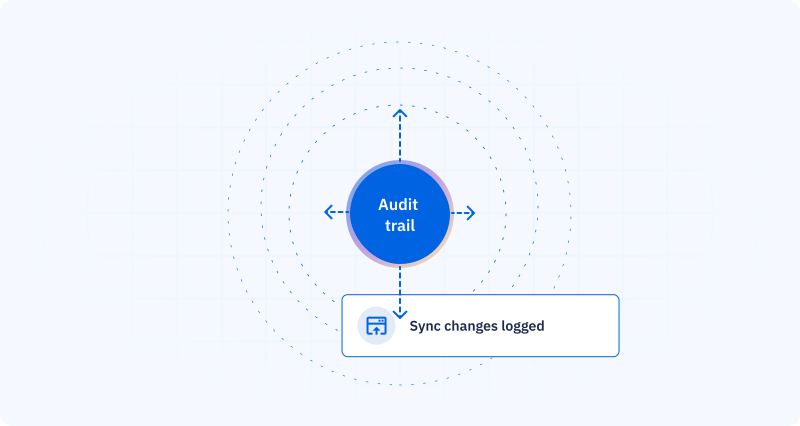
- Synced changes appear in the audit trail. If HR moves someone to a new role and the requirement set changes, the log should show that the change arrived from the HRIS at a timestamp. AG5 keeps a time-stamped audit trail capturing who changed what and when. Ask specifically how integration-driven changes are attributed within it.
- A sync cannot overwrite an assessed qualification. Role and site data flow in. Qualification records are owned by the skills system and should be immutable to the integration.
- Terminations archive rather than delete. Leaver records must survive the retention period your regulator requires, which in pharma and aerospace runs to years.
- Sync failures are visible. A broken integration that silently stops is worse than no integration, because everyone keeps assuming the data is current. Ask how failures surface, and to whom.
How these records are tested in practice is covered in compliance tracking software for manufacturing.
How to compare HR integration optionsCopied
Three questions sort most vendors quickly. Is there a maintained, named connector for your HRIS and your LMS, or a generic API and a services quote? Which direction does each connector support, and how fast does a termination propagate? And what happens on an identity conflict?
A vendor who answers all three in a demo, on your own HRIS rather than on a sandbox, has done this before. A vendor who answers them in a follow-up email has not.
A larger manufacturer carrying several HR systems from acquisitions has one more question. Can the skills system take people from more than one HRIS and hold them in one skill library? The answer decides whether the project consolidates the estate or reproduces it. Put that in the demo script rather than the contract.
Where AG5 fits in the HR and skills stackCopied
AG5 integrates with the HR, learning and scheduling systems frontline organizations already run. Maintained connectors cover Workday, SAP SuccessFactors, ADP Workforce Now, Cornerstone, Dayforce, BambooHR, UKG and 360Learning. An API covers the rest.
People and roles come in from the HRIS. Assignments go out to the LMS and completions come back. Qualification records stay owned and computed in AG5, with the assessment, the assessor and the evidence attached, and changes are logged in the audit trail. Manufacturers and logistics operators running multiple sites and multiple source systems use it as the one place qualification data is trusted.
If the current integration is a monthly CSV and a person who reconciles it, that is the arrangement it replaces.
FAQs Copied
-
What data should move between an HR system and a skills management system?
-
Does HR integration need to be real-time?
-
Which HR platforms have maintained connectors for skills management?
-
Can skills data be exported from HR software?
-
What usually goes wrong with an HRIS to skills integration?
Author Copied

Revisions Copied
Written by: Rick van Echtelt
Copy edited by: Adam Kohut