Training management systems for a global frontline workforce
Where the training requirement should live, how the stack fits together, and the six things to test before you buy.

 Reviewed by Adam Kohut
A food producer with 11 plants in six countries has, on average, eleven ways of deciding who needs which training. The LMS at head office holds the courses. What it does not hold is the reason each operator was assigned one, and that reason is the thing a training management system is supposed to own.
This guide is for operations and quality managers choosing a training management system for a distributed frontline workforce. It covers what the term actually means, and where the training requirement should live. It then works through how the system fits alongside HRIS, LMS and scheduling platforms. Finally, it covers what changes once the workforce spans sites, languages and regulators.
Three systems that get called “training management”Copied
Vendors use the phrase for three different products, which is why software shortlists so often contain tools that cannot be compared with each other.
Training administration tools schedule sessions, book rooms and trainers, and manage enrollment. They are built for training companies and for corporate L&D teams running classroom programs. They are good at logistics and indifferent to qualification.
Learning management systems host and deliver content, track completion and run assessments. Docebo, Absorb, Cornerstone and TalentLMS sit here, and most “training management” search results are LMS vendors describing their compliance features.
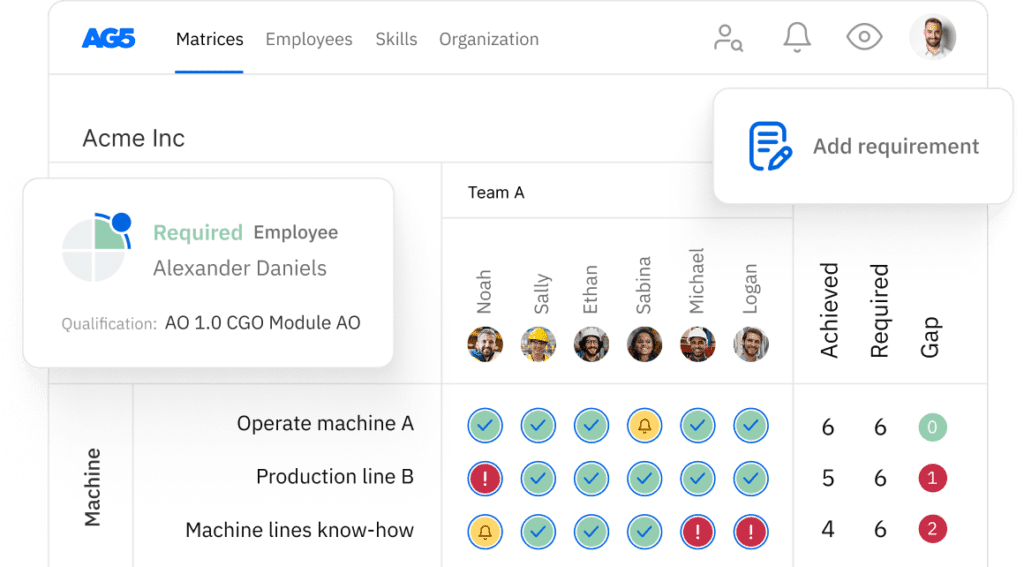
Skills and competency management systems hold the requirement: which qualifications each role, task and site needs, who currently holds them, and what is expiring. AG5 sits here. The full comparison is in competency management system vs LMS; this guide takes it as given and works out what a frontline operation needs from the combination.
For an office workforce the LMS alone often suffices, because the requirement is simple: everyone completes the annual policy course, once a year, in one language. For a frontline operation the requirement is the hard part, and it is the part no LMS was designed to hold.
Why doesn’t the training requirement live in the LMS?Copied
Because an LMS is built around content, and a frontline training requirement is built around context. The LMS can store a course and a list of people assigned to it. It cannot derive who should be assigned, because that derivation depends on the line, the product, the site’s regulator and the current procedure revision.
Consider one operator on a packaging line. Six things decide what she needs to be trained on. The line, the product family running on it, and the site’s local regulations. Then her role, whether she can work unsupervised, and which procedure revision is current. Change any one of those and the requirement changes with it.
An LMS cannot hold that logic. Someone still has to decide the assignments, and in most plants that someone is a coordinator with a spreadsheet. That is the eleven-ways problem, one coordinator at a time.
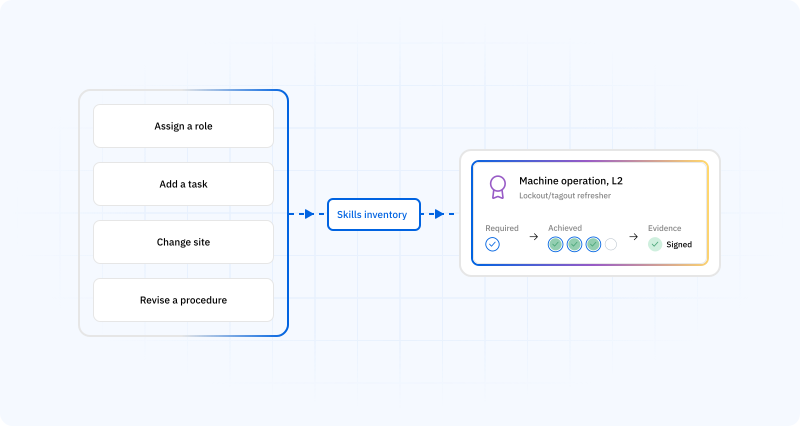
A training management system for frontline operations therefore has to own three things the LMS does not. First, the requirement matrix: role and task against qualification, held as training requirements that can be defined per role, per team and per machine. Second, the authorization status: trained, assessed, signed off, expired. Third, the derivation of training needs from the difference between the two.
When those three live in one place, the direction of travel reverses. The LMS receives assignments instead of generating them, and training planning becomes a queue instead of a project.
This is also the mechanism by which the system reduces skill gaps, and it is worth being precise about it. A gap is a required qualification that nobody available on the shift holds. If the requirement and the current state are both in the system, the gap is computed rather than discovered. The method for the analysis itself is in how to conduct a skills gap analysis.
How a training management system fits with HRIS, LMS and schedulingCopied
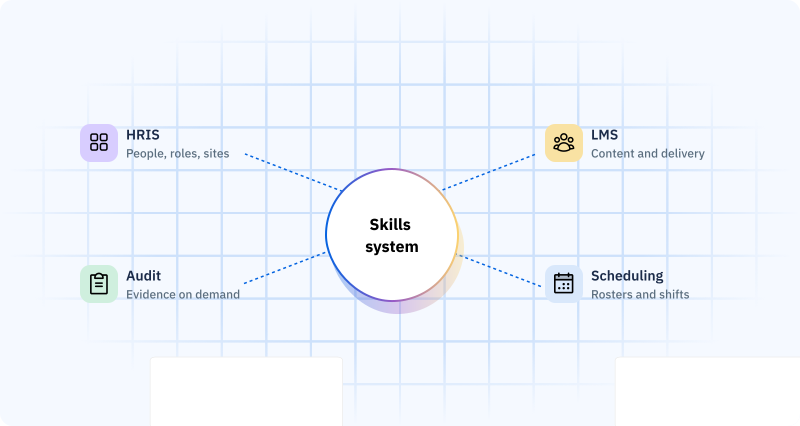
The arrangement that works in practice has four systems, each owning exactly one thing, and no two of them owning the same thing.
- HRIS (Workday, SAP SuccessFactors, ADP) owns who is employed, in which role, at which site. It feeds the skills system with people and roles and usually receives nothing back except a compliance flag.
- The skills and competency system owns the requirement and the authorization status. It computes training needs, pushes assignments to the LMS, receives completions back, and holds the assessment and sign-off that turns a completion into an authorization.
- The LMS owns content and delivery. It runs the course, records completion, and returns the result. External training providers plug in here, or feed certificates to the skills system directly.
- Scheduling and shift systems, where present, consume authorization status. The scheduler can then build a shift from people who are actually allowed to do the work, rather than from people who happen to be available.
The distinction that matters most in that list is between completion and authorization. A completed course is an event. An authorization is a judgment made by a named person, on a date, against a defined standard, and it is the only one of the two an auditor can act on.
The failure mode is letting the LMS own the requirement because it was there first. It works until the second site, and then the coordinator’s spreadsheet comes back to fill the gap between what the LMS knows and what the plant needs. AG5’s integrations cover the HRIS, LMS and scheduling connections in detail, including which direction each one supports.
Manufacturing execution systems are worth a separate note, because they come up in every architecture conversation and the market position is often overstated. An MES that consumes qualification status can warn before an unqualified operator is assigned to a work order. That capability depends on the specific MES and the specific connector, so treat it as something to verify in your own environment rather than as a given.
What are the challenges of managing training for a distributed workforce?Copied
Four things, and only one of them is about translation. Every requirement above gets harder with each site added, but the failures cluster around taxonomy, language at the point of sign-off, expiry across time zones, and the different ways regulators sample evidence.
One taxonomy, local requirements. The skill library has to be shared, so that “forklift operation” means one thing in Ohio and in Ontario, while the requirement attached to it can differ by site. A German plant needs an OSHA-equivalent set of safety qualifications under its own regulator. A Mexican plant needs the same skill names in Spanish. Systems that let each site build its own library produce a merger problem eighteen months later. There is no clean way to combine two libraries that disagree about what a skill is.
Language at the point of sign-off. The supervisor signing off a qualification on a phone at 3 a.m. is the person who has to understand the interface. Translating the admin console is not enough, because the admin console is not where the sign-off happens. AG5 runs in 20 languages, including English, Spanish, German, French, Polish, Italian, Portuguese and Turkish, on one shared library.
Time-zone-safe expiry. A certificate that expires at midnight has to expire at the site’s midnight, not at head office’s. It sounds trivial. It can produce a day where a plant believes it is covered and its own records disagree.
Regulator-specific evidence. An FDA investigator, a BRCGS auditor and an IATF assessor sample records differently, and a global producer may face all three in one year. The record has to be complete enough to satisfy the strictest of them. What each one tests is set out in compliance tracking software for manufacturing.
Of the four, the shared taxonomy matters most, because it is the one that cannot be fixed after the fact without re-entering the data.
How do you track mandatory and safety training?Copied
Safety training is the case where the requirement is simplest and the consequence of missing it is worst. Everyone in a zone needs the qualification, it expires on a fixed cycle, and the evidence is checked after an incident.
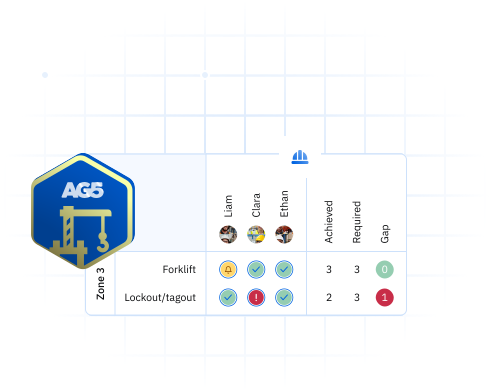
The design rule that follows is easy to state and frequently ignored. A training management system should attach a mandatory safety qualification to a location or a task, not to a person. Anyone who enters the zone then inherits it automatically. Attach it to people and you have to remember to attach it to every new person, which is exactly the step that gets missed during a busy week.
The evidence obligations are more specific than most buyers expect, and they sit in individual standards rather than in one general rule. OSHA’s powered industrial truck standard, 29 CFR 1910.178(l)(6), requires the employer to certify that each operator has been trained and evaluated. The certification has to name the operator, the training date, the evaluation date and the person who conducted it. The lockout/tagout standard, 1910.147(c)(7)(iv), requires a certification containing each employee’s name and training dates. A system that stores a completion tick and no assessor name cannot produce either record.
The training matrix is where all of this becomes visible in one view, and for ISO 9001 clause 7.2 it is usually the document an auditor asks to see first. That clause asks three things. Determine the competence needed for work affecting the quality management system. Ensure people are competent on the basis of education, training or experience. Retain documented information as evidence of it. Note the verb: retain, not maintain. The standard is asking for records, not for a policy document.
What should you test before buying a training management system?Copied
Six things, in roughly the order they decide it. Each one is a demo request rather than a question, because vendors answer questions more optimistically than they answer demos.
- Combined requirements. Can the requirement be defined by role, task, site and location, and can those be combined? Ask for a demo of one operator who works two lines at two sites.
- Authorization separate from completion. A completed course should not automatically mark someone qualified. Ask to see the step in between, and who is recorded as having performed it.
- LMS direction. Does it push assignments to your LMS and receive completions back, or does it expect to replace the LMS? Ask which specific platforms have a maintained connector rather than a generic API.
- One library, many sites. Is there a single skill library across sites with per-site requirements, and can a new site be onboarded from a template?
- Sign-off on the floor. Can a shift supervisor sign off a qualification from a phone, in their language, without an administrator in the loop?
- Evidence on demand. Can it produce the evidence pack for an auditor by person, procedure or site without someone assembling it by hand?
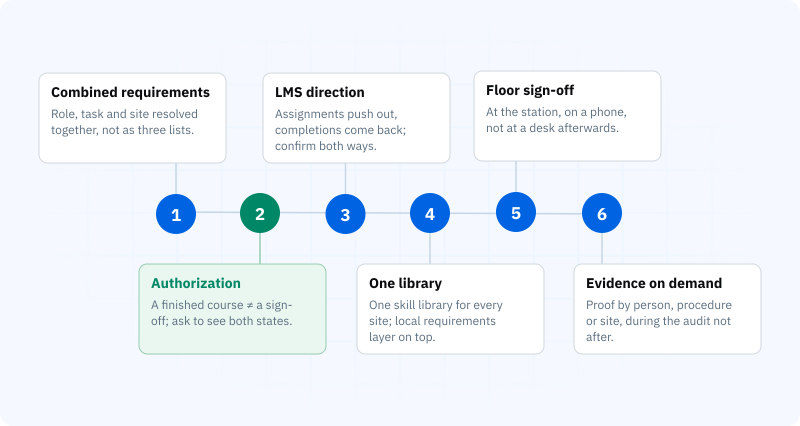
Two things are not on that list, on purpose. Content libraries, because the LMS owns delivery and a skills platform that also sells you courses is competing with a system you already have. And whether the system can build a training matrix. Do the first two things on the list well, and the matrix becomes a report the system generates. AG5’s best training matrix software comparison covers that layer separately.
Where AG5 fits in the training management stackCopied
AG5 is the skills and competency layer of the stack described above. It holds the requirement matrix and the authorization status for frontline-heavy, multi-site operations. Training needs are computed from the difference between the two. Assignments go out to the LMS. People and roles come in from the HRIS you already run, and audit evidence is produced on demand.
Manufacturers, pharmaceutical and food producers, logistics operators and automotive suppliers use it as the training management system of record while keeping their existing LMS for delivery. Cérélia, which runs around 2,000 people across 12 sites, replaced 400 individual personnel files with one platform and reports a 75% reduction in the time its audits take.
If the current arrangement is an LMS plus a coordinator plus a spreadsheet per site, that is the arrangement it replaces.
FAQs Copied
-
What is a training management system?
-
Do I need a training management system if I already have an LMS?
-
Can a training management system integrate with an existing LMS?
-
What does a training management system need to do in a regulated industry?
-
How does a training management system reduce skill gaps?
Author Copied

Revisions Copied
Written by: Rick van Echtelt
Copy edited by: Adam Kohut