Training needs analysis (TNA): how to find the training your workforce actually needs
A training needs analysis pinpoints the skills your workforce is missing so you train the right people on the right things.

 Reviewed by Adam Kohut
What is a training needs analysis?Copied
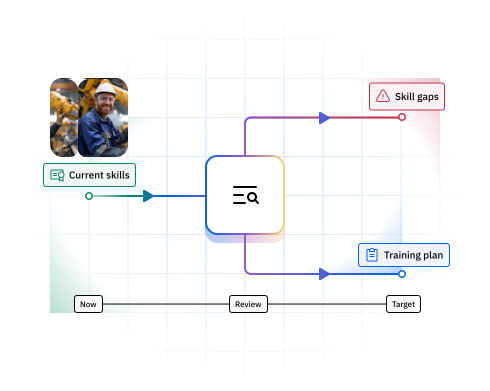
A training needs analysis (TNA), also called a training needs assessment, is a structured process for identifying the gap between the skills a workforce has and the skills it needs, then deciding which training closes that gap. It examines three levels, the organization, the job, and the individual, to pinpoint who should learn what, and why.
The output is not a report that sits in a drawer. A well-run TNA ends in a prioritized training plan: which programs to run, for whom, in what order, and what each one is expected to fix. L&D teams use it to scope and justify training spend. Operations and quality teams use it to prove that people meet the training requirements their roles demand.
Why TNA matters: Stop training wasteCopied
Most training budgets leak. Courses get booked because they ran last year, because a manager asked, or because a vendor pitched well. None of those reasons has anything to do with what the workforce actually lacks.
The sums involved deserve more rigor. US organizations spent $102.8 billion on training in the 2024-2025 period, according to Training magazine’s 2025 Training Industry Report, yet few L&D teams can show which portion of that spend changed anything on the floor. Untargeted programs produce exactly that problem: money leaves the budget, certificates get issued, and the gaps that matter stay open.
A training needs assessment replaces that guesswork with evidence. It tells you which gaps genuinely block performance, which people already meet the standard and can skip the course, and which problems are not training problems at all. That last point saves the most money: sending people to a workshop will not fix a staffing shortfall or a broken process.
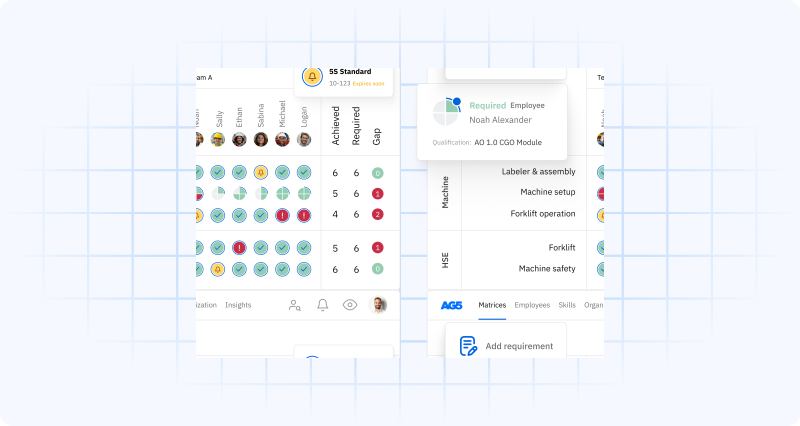
There is a defensive reason too. When finance asks what last year’s training bought, “completion rates” is a weak answer. A TNA lets you answer in operational terms: these gaps existed, this training closed them, and here is the re-assessment data that proves it. In regulated environments the same logic applies to auditors, who want to see that training maps to documented requirements rather than personal preference.
The three levels of TNACopied
A thorough analysis works through three levels in order. Each one narrows the focus of the last.
Organizational level
Where does the business need capability? Strategy, new product lines, expansion plans, compliance obligations, audit findings, and turnover hotspots all signal capability the organization must build. This level sets the direction and keeps the analysis tied to business outcomes.
Typical questions here: which goals are at risk because of missing capability, which sites or departments underperform their peers, and what do regulators or customers require that we cannot yet evidence? The answers rarely name individuals. They name directions.
Operational (task) level
What does each job require? This level defines the skills, knowledge, and proficiency each role needs to meet its standard, drawn from SOPs, equipment specifications, certification rules, and line managers. It produces the benchmark that individuals are measured against.
Ask of every role: what tasks does it perform, what standard defines done-well, which qualifications are legally required, and what goes wrong when the work is done badly? If a role profile cannot answer those questions, fix the profile before assessing anyone against it.
Individual level
Who currently falls short? Assessments, skills matrices, certification records, and performance data reveal where each person stands against the role benchmark. The result is a per-person picture of gaps, which is what turns analysis into an actionable plan. Data beats recollection at this level: a supervisor’s sense of who is struggling is a starting point, not a measurement, and it tends to overrate familiar people while underrating quiet ones.
The levels work as a funnel. Take a plant preparing to open a second shift: the organizational analysis identifies the capability the expansion demands, the operational analysis defines what each new-shift role requires, and the individual analysis reveals which current employees could cover those roles after targeted upskilling. Skip a level and the funnel clogs. Training decisions either float free of business goals or land on the wrong people.
How to conduct a TNA step by stepCopied
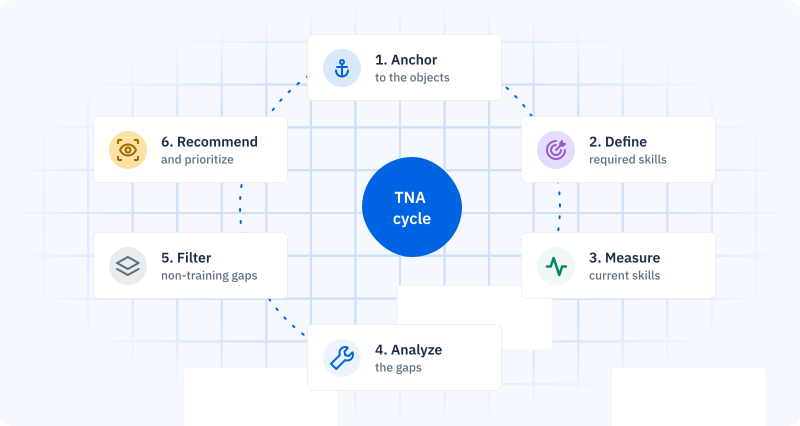
- Anchor the analysis to a business objective. Cut changeover time, pass an upcoming audit, staff a second shift. A concrete goal keeps the exercise from turning into a wish list of nice-to-have courses.
- Define the required skills for each role. Specify what each job demands and at what proficiency level, using SOPs, regulatory standards, equipment requirements, and input from supervisors. Documented requirements per role are the backbone of everything that follows.
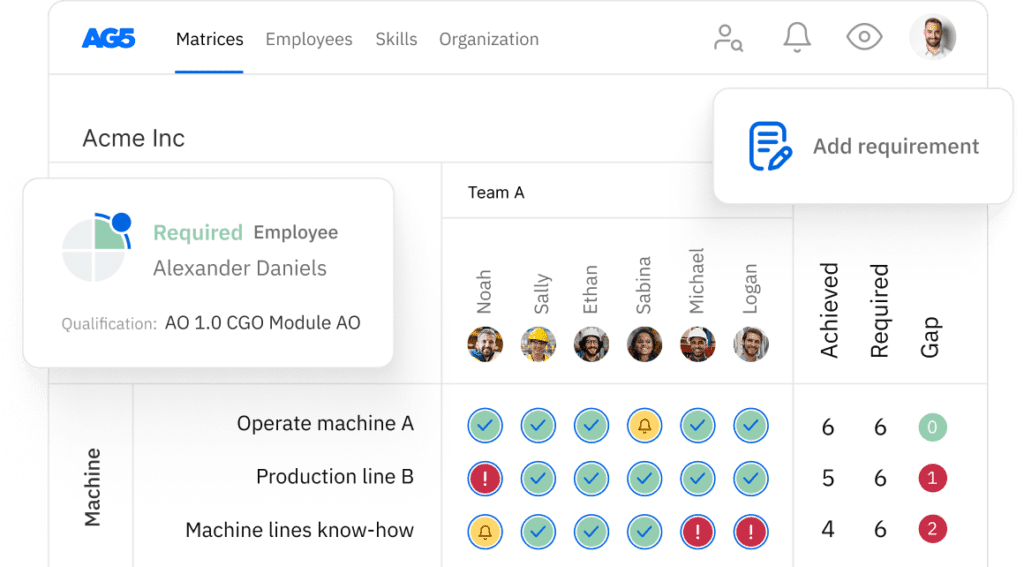
- Measure current skills against those requirements. Use competency assessments, practical observations, tests, and certification records. A live skills matrix gives you this picture continuously; an annual survey gives you a snapshot that ages fast.
- Analyze the gaps. Compare required against actual, person by person and team by team. Skill gap analytics show where shortfalls cluster, by site, department, or skill, so you can separate isolated gaps from structural ones.
- Separate training needs from other problems. Not every gap is a training gap. Some shortfalls trace back to understaffing, unclear procedures, or worn-out tooling. Training fixes a missing skill; it cannot fix a missing person or a bad process, so filter those items out before they consume budget.
- Recommend training and set priorities. Match each confirmed need to the right method: on-the-job instruction, coaching, formal courses, or certification programs. The deliverable is a ranked plan, not a course catalog.
Where the data comes from
A TNA is only as good as its inputs, and each collection method has a distinct job:
Combine at least three. Records tell you who is qualified on paper, observation tells you who performs in practice, and interviews tell you why the two disagree.
Turning findings into a prioritized training planCopied
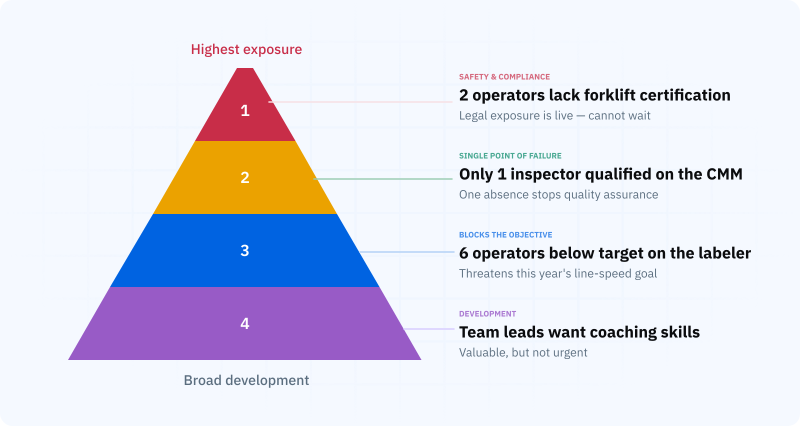
Raw gap data becomes useful when you rank it. Safety and compliance gaps come first, because the cost of leaving them open is measured in incidents and failed audits. Next come single points of failure, where only one person holds a critical skill. Then gaps that directly block the business objective you anchored the analysis to, and finally broader development needs.
A worked example makes the ranking concrete. Suppose the analysis of a packaging department surfaces four findings: two operators lack a legally required forklift certification, one inspector is the only person qualified on a critical measurement device, six operators sit one level below target on a new labeler, and several team leads have asked for coaching skills. The plan orders itself. Certifications come first because the compliance exposure is live, the measurement device second because it is a single point of failure, the labeler third because it blocks this year’s line-speed objective, and coaching last, valuable but not urgent.
For every item on the plan, record who is being trained, in what, by which method, by when, and who owns delivery. A training matrix keeps that record live, so priorities stay tied to who is actually qualified. Add the measure of success up front, usually a re-assessment against the same criteria used in the analysis. Without that closing step, you can prove attendance but never impact.
Feed the plan into your wider L&D strategy so the analysis becomes a repeating cycle rather than a one-off project. A sensible cadence is a full training needs assessment annually, with trigger-based updates whenever new equipment, regulations, or restructuring changes what roles require.
TNA vs Skills/Competency gap analysisCopied
The terms overlap enough to cause real confusion, but the distinction is simple. A skills gap analysis measures the distance between the skills people have and the skills their roles require. It is a diagnostic. A training needs analysis is the broader process that uses the diagnosis to decide which training to run, for whom, and in what order.
A competency gap analysis applies the same diagnostic logic against a competency framework, which covers behaviors and knowledge as well as technical skills. Whichever variant you run, its output feeds step 4 of the TNA process described above.
In practice the sequence runs: define requirements, run the gap analysis, then let the TNA decide what to do with the results. Teams that jump straight to booking courses are effectively running a TNA with the analysis removed, which is how training waste gets institutionalized.
Free templateCopied
A working TNA template needs nine fields per row: employee or role, required skill, target proficiency level, current level, gap size, priority, planned action, owner, and deadline. Set it up so the gap column calculates itself and the priority column follows the ranking rules above.
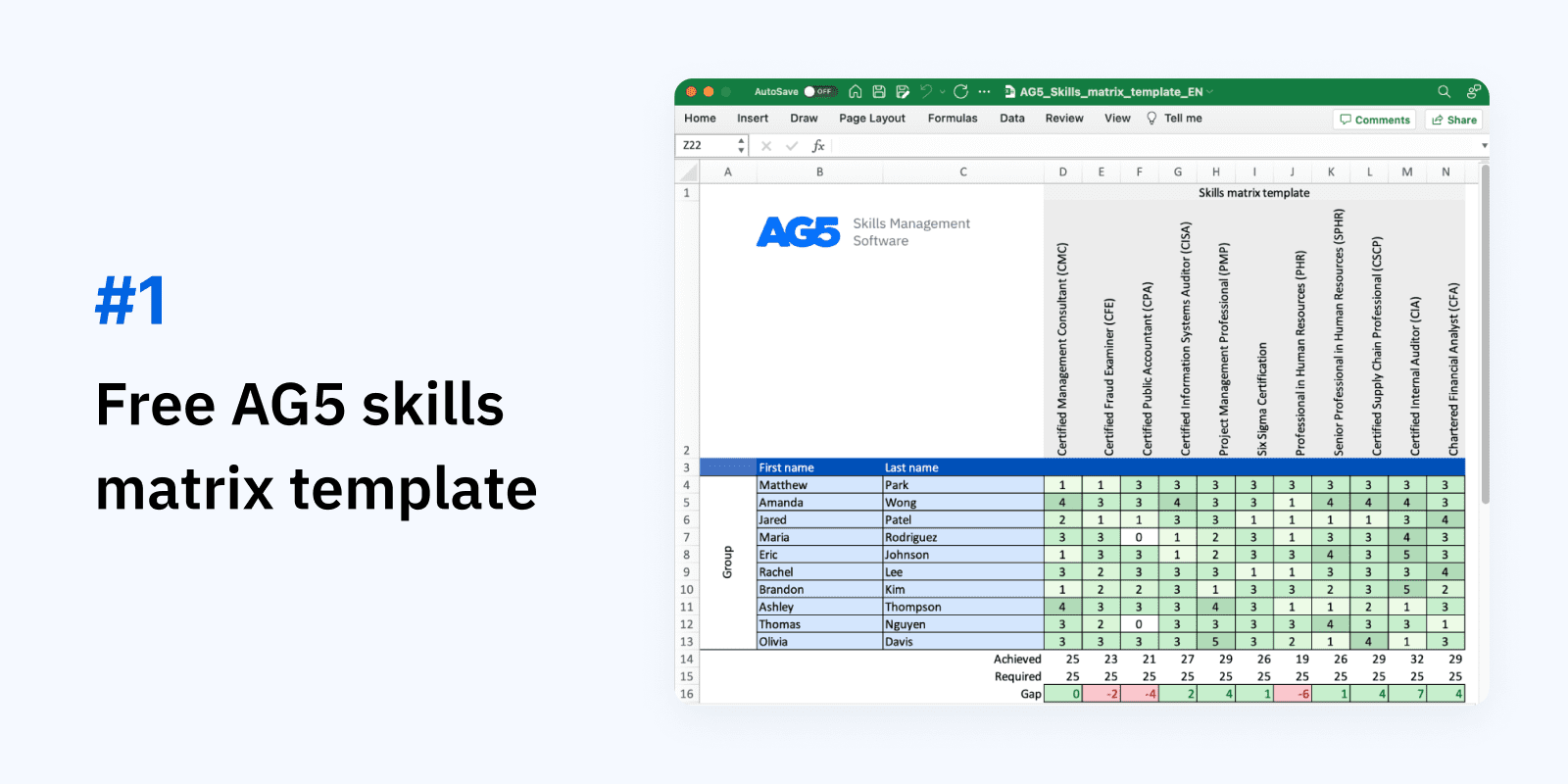
AG5’s free skills matrix templates give you a ready-made structure for the measurement half of that table, which is the part teams most often get wrong. Start by building the current-versus-required picture in the matrix, then layer the planning fields on top.
The measurement half goes stale first; the planning half only works while the numbers underneath it are true. If you would rather start from a gap-first layout, our skills gap analysis template lays out those fields in a ready-made grid.
FAQs Copied
-
What is the difference between a TNA and a skills gap analysis?
-
What are the three levels of training needs analysis?
-
How often should you conduct a training needs analysis?
-
What should a training needs analysis template include?
-
Is a training needs assessment the same as a training needs analysis?
Author Copied

Revisions Copied
Written by: Rick van Echtelt
Copy edited by: Adam Kohut