What is a management competency model? [A 2026 guide]
A management competency model defines the skills and behaviours every manager needs, and the level required for each role. Learn how to build one, with examples from manufacturing and regulated industries.

 Reviewed by Adam Kohut
A management competency model is a structured framework that defines the skills, knowledge, and behaviours required for effective management in a specific organisation or role. It sets out what ‘good’ looks like for every manager in your business, and makes that standard measurable, consistent, and auditable.
For operations, quality, and training teams in manufacturing and regulated industries, a management competency model is not a nice-to-have. It is the foundation for workforce planning, skills gap identification, and compliance with standards such as ISO 9001 and ISO 45001. For a broader overview of the discipline, see what is competency management.
What is a competency model?Copied
A competency model is a defined set of skills, knowledge, and behaviours that an individual needs to perform a role effectively. Each competency is written as a clear, observable standard, not a vague aspiration, and is assigned a proficiency level that reflects what the role actually requires.
Competency models exist at different levels. A company-wide competency framework covers the full range of roles across an organisation. A role-specific competency model narrows that down to the exact competencies and proficiency levels required for a single position, a shift manager, a quality inspector, a production supervisor.
The distinction matters because a model without specificity is not a model, it is a wish list. The value of a competency model is in the precision: this role requires this skill at this level, and we can assess against it.
What makes a management competency model different?Copied
A general competency model covers what someone needs to do a job. A management competency model covers what someone needs to lead others doing that job, and that is a meaningfully different set of requirements.
Four areas distinguish the management version:
- Leadership behaviours under pressure: Managers in operational environments make decisions that affect safety, output, and compliance in real time. A management competency model must define what good leadership looks like when the line stops, a non-conformance is raised, or a safety incident occurs, not just during steady-state operations.
- Decision-making within defined authority: Effective management in regulated environments requires knowing which decisions to make independently and which to escalate. This is a competency that needs to be defined, not assumed.
- Team capability oversight: Managers are responsible for ensuring the people they lead are competent for the tasks they perform. In ISO-regulated environments, this is a clause requirement, ISO 9001 clause 7.2 makes it explicit. A management competency model should include the manager’s responsibility for workforce competency, not just their own.
- Accountability at scale: As role scope increases, the model must reflect the shift from individual task execution to managing performance, compliance, and skills development across a team or shift.
Generic competency frameworks, the kind produced for white-collar professional roles, do not account for any of this. A manufacturing or operations management competency model needs to be built for the environment its managers actually work in.
Core components of a management competency modelCopied
A well-structured management competency model contains three types of competency, each with defined proficiency levels:
| Component | What it covers | Examples in an operational context |
|---|---|---|
| Technical competencies | Role-specific knowledge and skills required to perform the job | Equipment operation, process knowledge, safety systems, quality procedures |
| Behavioural competencies | How a manager approaches work, decisions, and people | Accountability, structured problem-solving, safety leadership, escalation discipline |
| Leadership competencies | Capabilities specific to managing a team | Coaching, performance review, competency gap identification, workforce planning |
Each competency in the model should be assigned a proficiency level, typically on a 1–4 or 1–5 scale. The levels define what the competency looks like at each stage, from awareness through to expert or authorizing standard. Without proficiency levels, a competency model cannot support meaningful assessment.
A skills matrix template is a useful starting point for mapping competencies across roles before building them into a formal model.
Management competency model examplesCopied
The following examples are drawn from AG5’s core industries: manufacturing, operations, and quality management in regulated environments.
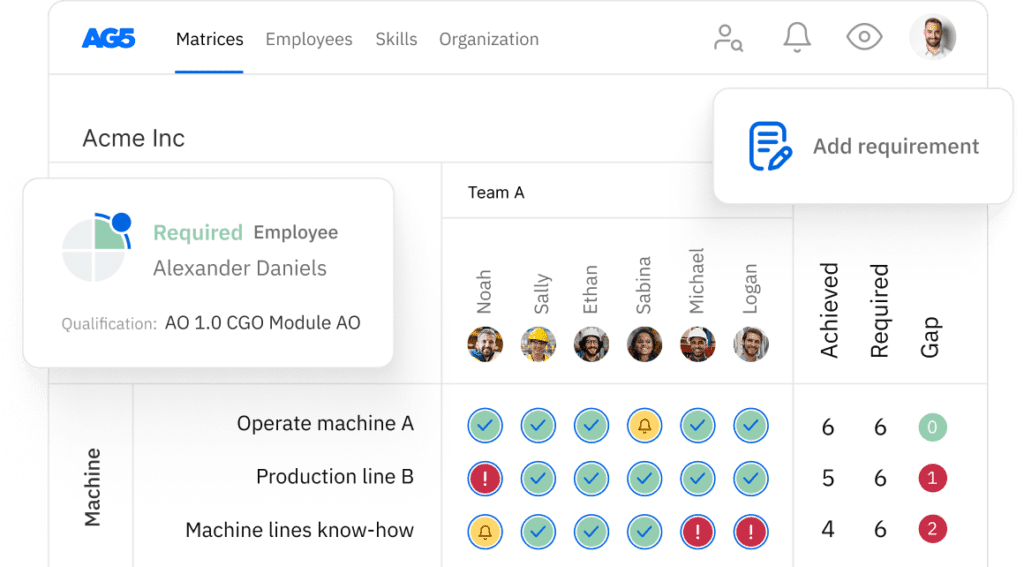
Each model is structured around the competencies that directly drive performance and compliance in that role.
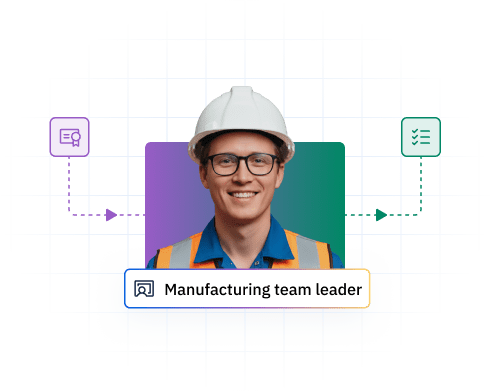
1. Manufacturing team leader competency model
A manufacturing team leader is responsible for shift output, team safety, and process adherence. Generic competency models, built around communication and teamwork, do not capture what this role actually demands. A role-specific model should include:
- Safety compliance and hazard identification. Ability to apply site safety procedures, conduct pre-shift checks, and respond to near-miss events within defined protocols.
- Process adherence and deviation management. Knowledge of standard operating procedures (SOPs) and the judgement to identify and escalate deviations before they affect output or quality.
- Skills coaching and on-the-job assessment. Ability to assess team members against defined task competencies and provide structured on-the-job training.
- ISO 9001 / ISO 45001 clause 7.2 compliance. Understanding of the organisation’s obligations under clause 7.2, determining the necessary competence of persons performing work, and ensuring evidence is maintained.
- Equipment authorisation management. Knowing which team members are authorized for which equipment, and ensuring no unauthorized operation occurs on shift.
2. Operations manager competency model
An operations manager works across multiple teams, shifts, or production lines. Their competency model shifts from task execution to workforce orchestration:
- Workforce planning by skill. Ability to plan shift coverage against a skills matrix, ensuring the right people with the right authorisations are in the right positions at the right time.
- Risk and gap management. Identifying capability gaps before they become operational risks, through regular skills gap analysis and succession planning.
- Audit preparation and readiness. Maintaining the records, training logs, and competency evidence needed to pass internal and third-party audits at any point in the year.
- Cross-functional escalation and decision-making. Knowing when to escalate quality, safety, or performance issues beyond the production environment and how to present them clearly.
- Succession readiness. Identifying and developing individuals within the team who can step up to more senior roles, reducing single points of failure in critical positions.
A structured competency gap analysis is a key tool for operations managers to identify where workforce capability does not meet the model’s requirements.
3. Quality manager competency model (ISO-regulated)
Quality managers in ISO-regulated manufacturing environments carry specific responsibilities that must be reflected in their competency model:
- Internal audit management. Planning and executing internal audits against ISO 9001 or ISO 45001 requirements, including evidence review, interview technique, and non-conformance classification.
- Non-conformance response and root cause analysis. Identifying root causes using structured methodologies (8D, 5-Why) and driving corrective actions through to closure.
- Regulatory knowledge and standards application. Current, working knowledge of applicable ISO standards and their implications for operational processes and documentation.
- Training sign-off and competency verification. Authority to approve competency assessments and training records, and responsibility for ensuring the training matrix is current and complete.
- Corrective action tracking and closure. Managing the full CAPA (Corrective and Preventive Action) cycle, including verification that actions have been implemented and are effective.
How to build a management competency framework in 5 stepsCopied
Building a management competency framework is a structured process. The steps below are designed for Operations Managers and Training Coordinators who need to create something functional and auditable, not a theoretical exercise.
- Define the roles and scope. List the management roles you are building the framework for. Be specific, a shift supervisor and a plant manager are not the same role and should not share the same model. Scope the project before writing a single competency.
- Identify the competencies required for each role. For each role, list the technical, behavioural, and leadership competencies the role genuinely requires. Involve the people in those roles and their line managers. Limit each model to 8–15 competencies, enough to be meaningful, not so many that assessment becomes unmanageable.
- Define proficiency levels. For each competency, set the level required for the role (e.g., 1 = Awareness, 2 = Practitioner, 3 = Proficient, 4 = Expert/Authorizing). The role’s required level becomes the benchmark for assessment.
- Map competencies to assessment criteria. Each competency should have observable assessment criteria, what does it look like in practice when someone meets or exceeds the required level? Without this, assessments are subjective and not auditable.
- Build in a review and update cycle. Competency models become outdated as processes, standards, and regulations change. Set a formal review cadence, annual at minimum for most operational roles, more frequently where regulatory requirements are updated.
See how AG5 turns your competency framework into a live, auditable system.
Common mistakes when building competency modelsCopied
The most common reasons competency models fail to deliver value:
- Too many competencies. A model with 30 competencies is not more thorough, it is less usable. Assessment fatigue sets in, managers do not complete them, and the data becomes unreliable. Keep each model to the competencies that genuinely differentiate strong performance.
- Generic frameworks applied to specific roles. A competency model downloaded from an HR website was not written for a shift supervisor in a food manufacturing plant. The language, the examples, and the standards will not match the environment, and the people being assessed will know it.
- No proficiency levels defined. Without defined levels, every assessment is a binary pass/fail against a vague standard. You lose the ability to track development, identify partial gaps, or plan targeted training.
- No system to manage them at scale. Building the model is step one. Managing assessments, tracking expiry dates, maintaining audit evidence, and reporting gaps across a workforce of 200 people cannot be done reliably in a spreadsheet. At scale, a manual approach creates the compliance risk it was meant to prevent.
How AG5 helps you manage competency models at scaleCopied
Defining a management competency model is the essential first step. Managing it across a workforce, tracking assessments, monitoring proficiency against targets, flagging gaps, and generating audit evidence, requires a system. That is where competency management software becomes critical.
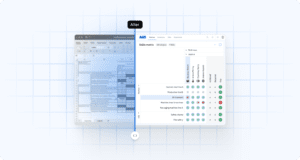
AG5 is a competency management system built for manufacturing, aerospace, oil and gas, and logistics environments. Once your competency model is defined, AG5 makes it operational:
- Map competencies to roles at defined proficiency levels across your full workforce.
- Assign and track assessments against targets, with automated gap identification.
- Flag certification expiry and training requirements before they become compliance issues.
- Generate audit-ready reports on demand, with full evidence trails for ISO 9001 / ISO 45001 clause 7.2 requirements.
- Use competency assessment software to run structured assessments and maintain a complete assessment history.
The model defines what good looks like. AG5 makes it visible, trackable, and auditable across every role in your organisation.
Ready to manage competency models at scale? Book a free demo of AG5.
FAQs Copied
-
What is a management competency model?
-
What is the difference between a competency model and a competency framework?
-
How many competencies should a management competency model have?
-
How does a competency model connect to a competency management system?
-
Can I use AG5 to manage our management competency model?
Author Copied

Revisions Copied
Written by: Rick van Echtelt
Copy edited by: Adam Kohut