
How GKD Group eliminated the compliance risk in its outdated spreadsheets
All certificates centralized, managers empowered, and audit readiness restored.
A specialist manufacturer with a complexity problem
GKD Group weaves metal and plastic wires into technical fabrics used across a wide range of industrial applications. It’s exacting work, and the workforce behind it needs to be just as precisely tracked and certified, not to mention audit-ready at any given moment.
“Before we started using AG5, we had Excel sheets. We then upgraded to a macro-based Excel sheet,” said Lena Müller-Frommeyer, HR Specialist Learning & Development at GKD Group. “There were still a lot of errors and a lot of individual mistakes. Keeping it up to date was really hard.”
The upgrade from a basic Excel to a macro-driven one is a familiar story, a workaround built on top of a workaround, with each iteration adding complexity without actually solving the underlying problem. At a certain point – and on top of its inefficiency – the system becomes a liability.

A workload that had become unsustainable
There was less of a tipping point than accumulated pressure. Manual processes were multiplying, coordination was becoming unmanageable, and the compliance issues were growing harder to ignore.
“I just wasn’t able to do the workload anymore, and there were too many legal risks that were associated with it,” Müller-Frommeyer said. “Our biggest operational risk was definitely not being audit ready.”
That combination of personal workload and institutional risk forced the search for something better. GKD came to the process with a clear sense of what they needed and evaluated the market.
“AG5 was the only one that was able to meet all the requirements we had,” Müller-Frommeyer said.
We had a whole lot of manual processes that needed to be coordinated and I just wasn’t able to do the workload anymore.
Lena Müller-Frommeyer
HR Specialist Learning & Development, GKD Group
The features that made the difference
A few specific capabilities stood out once GKD was up and running. The color-based skill gap analysis gives anyone a read on qualification status at a glance, no interpretation required. Crucially, the planning function connects directly to it, so when a gap appears, the system attaches a training plan to the relevant certificate on the spot.
Certificates themselves were a persistent source of friction before; managers were constantly asking where to find them and who held them.
“Now they’re just stored directly, everyone has access, and that made life a lot easier for a lot of people,” Müller-Frommeyer said.
HR software integration was another deciding factor, as GKD wanted the ability to connect AG5 to its existing systems rather than running a parallel process.
I like the color-based skill gap analysis. So you see at first sight if you have a gap or not.
Lena Müller-Frommeyer
HR Specialist Learning & Development, GKD Group
Ownership where it belongs
For GKD, skills matrices that used to require constant central maintenance are now something people engage with directly.
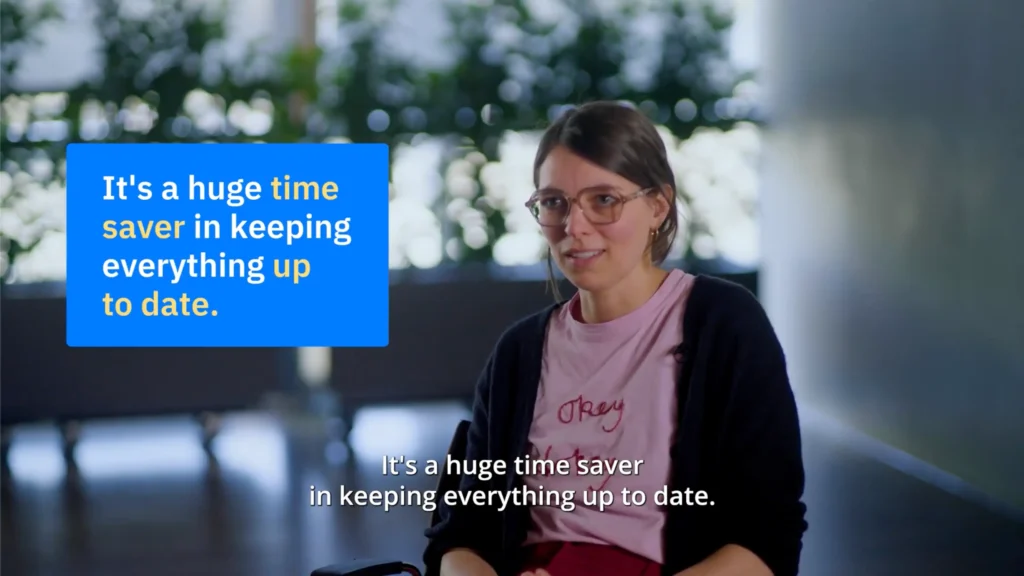
“I see that we were able to standardize a lot of the skills. People are taking ownership of their matrices. It’s a huge time saver in keeping everything up to date,” Müller-Frommeyer said.
When the data is visible and accessible, the responsibility for maintaining it doesn’t have to sit with one person. Such a redistribution of ownership, away from a single overwhelmed coordinator and toward the people the data is actually about, may be the most durable change of all.