How to build an employee development plan people actually follow
Learn what an employee development plan is, why most fail, and how to build one with examples for manufacturing, logistics, and operations.

 Reviewed by Adam Kohut
What is an employee development plan?Copied
An employee development plan (EDP) is a structured document that maps an employee’s current skills and competencies against the capabilities their role requires, and defines the specific actions, resources, and timelines needed to close the gap.
It is forward-looking. A performance review tells you how someone performed. An employee development plan tells you what they need to become better at and how they will get there.
Done properly, it is a working document that changes what an employee focuses on developing and what training budget gets allocated. It is revisited regularly enough to reflect the current state of the person, not the state they were in 12 months ago.
Employee development plan vs. Individual development plan vs. Career development planCopied
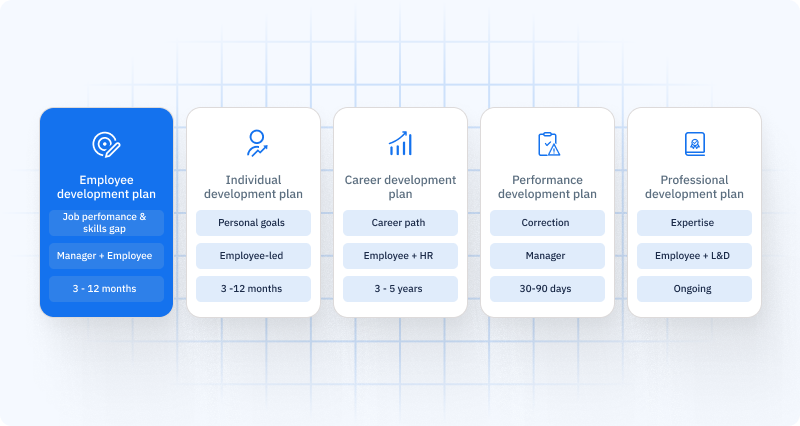
These terms are used interchangeably in the market, which creates confusion about what each is actually for. They are related but distinct.
| Term | Focus | Typical owner | Time horizon |
|---|---|---|---|
| Employee development plan (EDP) | Closing gap between current and required competency for current role | Manager + employee | 6 to 12 months |
| Individual development plan (IDP) | Broader personal growth, current role AND future career aspirations | Employee-led, manager-supported | 12 to 36 months |
| Career development plan | Progression pathway toward a future role or level | Employee + HR | 2 to 5 years |
| Performance development plan | Addressing performance deficiencies, triggered by underperformance | Manager + HR | 30 to 90 days |
| Professional development plan | Building expertise and professional standing in a discipline | Often individual-driven | 1 to 3 years |
An EDP is the most operationally immediate. It addresses what this person needs to be better at in their current role, right now. A performance development plan is triggered by a problem. An EDP is part of standard practice for all employees.
Why most employee development plans don’t workCopied
Every manager and HR team knows how this goes. Development planning season arrives. Managers sit down with their reports. Someone writes down three goals in a form. The form gets filed. It is retrieved 12 months later, updated slightly, and filed again. The plan never changed what the employee actually focused on developing.
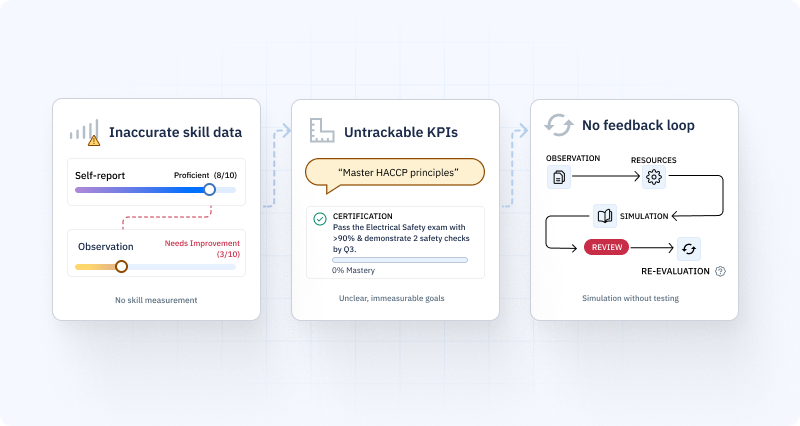
Failure mode 1: Plans built on unreliable skills data
The foundation of every employee development plan is a current skills assessment. And in most organizations, that assessment is a self-assessment: the employee rates their own capabilities, the manager may or may not review it, and the plan is built from that data.
Research consistently shows that people rate their own competencies higher than objective assessors do. The employees who most need development in a skill are often the least aware of how far below standard they are. A development plan built on self-reported skills data starts from the wrong baseline.
The most useful employee development plans are built on validated competency assessments, where a manager has observed actual performance, where evidence exists, and where the gap between required and demonstrated competency has been objectively measured.
Failure mode 2: Goals that can’t be measured
‘Improve communication skills’ is not a development goal. ‘Deliver the Q3 client update to the leadership team independently, assessed by the commercial director, by September’ is a development goal. Without measurability there is no way to know whether the plan worked, which is why the same goals tend to reappear in next year’s plan.
Failure mode 3: No connection to ongoing competency tracking
The development plan is created in January. In March, the employee completes a training course that was supposed to address a key gap. Nobody re-assesses the competency to check whether the gap actually closed. Training was completed; competency may or may not have developed. The closed loop (assess, intervene, re-assess, confirm) is almost never executed systematically. Effective competency management requires that loop to be built into the workflow, not treated as optional.
What an employee development plan should includeCopied
A well-structured employee development plan contains six components. Missing any of them tends to produce a document rather than a tool.
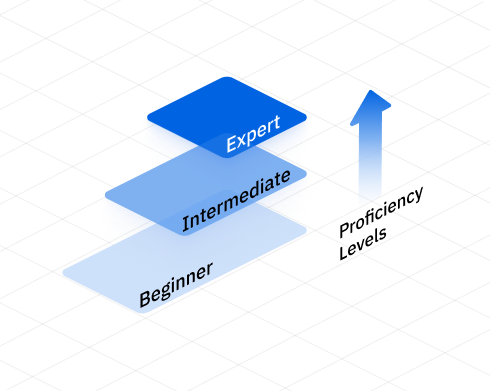
- Current competency assessment — manager-validated baseline showing where the employee sits against the requirements of their role, using a defined proficiency scale
- Development goals — specific, measurable targets for where each competency needs to reach, tied to observable outcomes
- Development activities — specific actions to close the gap: formal training, coaching, mentoring, stretch assignments, job shadowing. Matched to the type of gap.
- Resources and support — budget, time allocation, access to coach or mentor. Plans that make no commitment of resource are statements of aspiration.
- Timeline and milestones — completion dates, re-assessment dates, review checkpoints
- Success criteria — how will you know the gap has closed? What evidence confirms the development activity worked?
Employee development goals: Types and examplesCopied
Technical skills development goals
- Complete ISO 9001 Lead Auditor certification by Q3, validated by passing the external assessment
- Operate forklift to OSHA 29 CFR 1910.178 standard, assessed by shift supervisor, by end of month 2
- Demonstrate Level 3 proficiency in SAP production module, validated by line manager, within 90 days
Leadership and management development goals
- Lead a cross-functional project team of 6 from kick-off to delivery, assessed by project sponsor, by Q2
- Complete first full performance review cycle for direct reports independently by December
- Present monthly production performance report to department head without support by month 3
Compliance and regulatory development goals (critical for regulated industries)
- Renew confined space entry certification before current certificate expires
- Complete annual hazard communication refresher (OSHA 29 CFR 1910.1200) by [date]
- Sign off on updated SOP for Line 4 within 30 days of procedure change
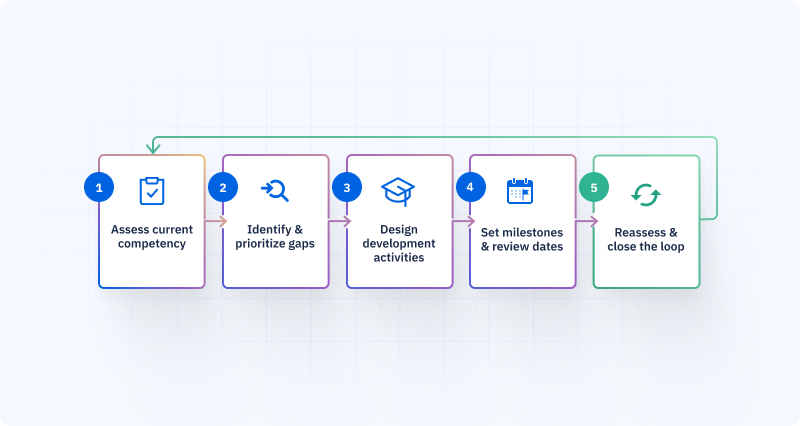
How to create an employee development plan in 5 StepsCopied
Step 1: Assess current competency against role requirements
Map the competencies the role requires. Assess where the employee currently sits against each one, using a defined proficiency scale, manager observation, and evidence where available. The employee’s self-rating is a useful starting point for conversation, but the manager’s assessment drives the plan. For regulated roles, this assessment needs to generate evidence: a signed observation record, a completed assessment form, a valid certification. Using skill assessment software ensures this step produces reliable, auditable data rather than guesswork.
Step 2: Identify and prioritize gaps
Compare current competency against required competency. Not all gaps are equal. Prioritize by risk (which gaps create safety, compliance, or operational risk?), impact (which gaps most limit effectiveness?), and achievability (what can realistically be developed within the plan period?). A development plan with 12 goals is a development plan for nobody in particular. A structured skills gap analysis helps rank gaps by operational urgency rather than gut feel.
Step 3: Design targeted development activities
Match the intervention to the type of gap: knowledge gaps need structured learning, skill gaps need practice under observation, certification gaps need formal training programs, behavioral gaps need coaching and feedback loops. For each activity, define what it involves, who supports it, when it happens, and what evidence of completion it produces.
Step 4: Set milestones and review dates
Set a completion date for each development activity. Set a competency re-assessment date, not just a training completion date. Schedule a mid-plan review at 90 days to assess whether the plan is on track and adjust if not. Development plans without dates drift.
Step 5: Re-assess and close the loop
Once development activities are complete, re-assess the competency. Has the gap closed? Has it partially closed? Is a further intervention needed? Update the record. This is what turns a development plan from a compliance exercise into a mechanism that actually changes capability. It is the most neglected step in the entire process.
Employee development plan examplesCopied
Manufacturing production operator
Gap: below Level 3 proficiency on quality inspection, required for quality lead promotion
| Development goal | Activity | Timeline | Success criteria |
|---|---|---|---|
| Reach Level 3 on visual inspection | Shadow quality lead (5 shifts) + 3 assessed practice sessions | 8 weeks | Manager assessment: Level 3 confirmed |
| Complete ISO 9001 awareness training | Internal course | 4 weeks | Assessment pass + certificate |
| Conduct first independent quality check | Supervised then unsupported check on Line 2 | Week 10 | Supervisor sign-off on completed inspection |
Logistics coordinator
Gap: dangerous goods certification due for renewal; no experience with import documentation
| Development goal | Activity | Timeline | Success criteria |
|---|---|---|---|
| Renew ADR dangerous goods certification | External provider course | 6 weeks | Certificate renewed, uploaded to records |
| Learn import documentation process | Mentoring with senior logistics manager (4 sessions) | 3 months | Independently complete 3 import declarations |
Operations manager
Gap: leadership competencies below required level; limited experience managing underperformance
| Development goal | Activity | Timeline | Success criteria |
|---|---|---|---|
| Lead first formal performance review cycle | Supported by HR, independent execution | Q3 | Two completed reviews, HR sign-off |
| Complete management development program | External 3-day program | Month 2 | Certificate + reflective log submitted |
| Manage one underperformance case | Coaching support from HR throughout | Q3 to Q4 | Documented improvement plan created and followed |
Connecting development plans to real skills dataCopied
The most common failure mode in employee development planning is building the plan on the wrong data. Self-reported annual assessments produce biased, stale baselines. Development interventions get designed around the wrong gaps. Training budget goes to the wrong places. A year later, the same gaps appear in the next development plan.
The organizations that get consistent value from development planning are the ones that have solved the data quality problem first. Skills assessed using a consistent framework. Competency records updated automatically when training is completed. Development plan reviews built into the workflow, not an optional add-on.
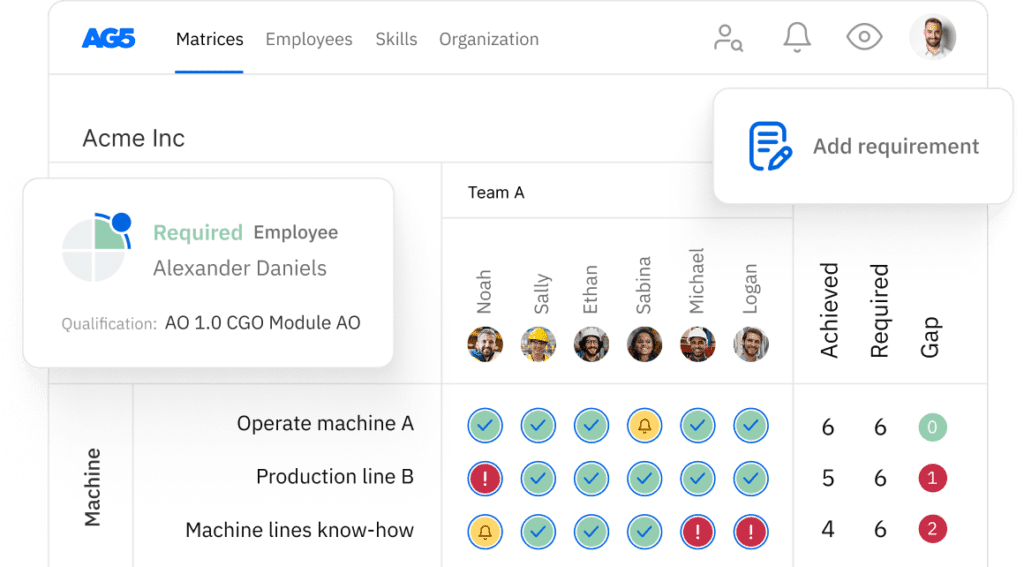
AG5 provides the validated skills data that makes development plans evidence-based rather than assumption-based. Skills are assessed against defined competency frameworks, validated by managers, and tracked continuously. Gap analytics show exactly which employees are below required competency level and by how much. Development plans built on AG5 data start from a reliable baseline.
Free employee development plan templates
AG5’s template library includes a standard EDP template, an operational development plan template (with compliance and certification fields), and an IDP template for career progression planning. Download all templates free in Excel format at ag5.com.
FAQs Copied
-
What is an employee development plan?
-
What is the difference between an employee development plan and an individual development plan?
-
What is the difference between a development plan and a performance improvement plan?
-
What should an employee development plan include?
-
How long should an employee development plan cover?
-
How do you measure whether an employee development plan worked?
-
What makes a development goal effective?
-
How does AG5 support employee development planning?
Author Copied

Revisions Copied
Written by: Rick van Echtelt
Copy edited by: Adam Kohut