What is competency management?
Competency management is the process of identifying, assessing and developing employee skills. Learn how a modern system like AG5 can replace spreadsheets and close skills gaps at scale.

 Reviewed by Adam Kohut
Competency management is the process of identifying the skills and knowledge employees need to perform their roles, assessing their current proficiency against defined targets, and closing any gaps through structured development. It provides a structured, repeatable way to ensure that every person in your workforce can actually do what their role requires, at the level the business needs. For manufacturing and regulated-industry teams, it is the foundation of both operational performance and compliance, and in 2026, it has never been more business-critical.
The concept covers everything from how you define the skills required for a role, to how you measure whether someone has them, to how you track that evidence over time. If you want to understand the difference between competency vs proficiency, two terms that are often used interchangeably but mean different things, that distinction is directly relevant to how you set up your framework.
The competency management processCopied
Competency management is not a one-off project, it is a continuous four-step cycle. Where organisations go wrong is treating it as something you set up once and come back to annually.
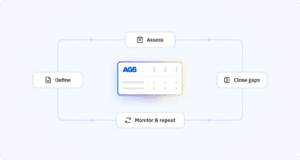
In high-compliance, fast-changing environments, the cycle needs to run continuously. Each step builds on the last:
- Define competencies. Identify the skills, knowledge and behaviours required for every role in your organisation. This is your competency framework, the baseline everything else is measured against
- Assess employees. Measure each person’s current proficiency against those defined competencies. Use structured assessments, manager sign-off, or third-party certifications depending on the role and regulatory context
- Close gaps. Where employees fall below the required proficiency level, assign targeted training. Connect every gap directly to a learning intervention, not a generic training calendar
- Monitor and repeat. Skills change. Roles evolve. Regulations update. Reassess on a regular cycle so your workforce data stays current and actionable
In a manufacturing environment managing 500 workers across 66 skills, running this cycle manually is impossible. That is where a competency management system replaces the spreadsheet and makes the process scalable.
Why competency management matters in 2026Copied
Three forces are converging to make competency management more urgent than it has ever been:
AI-driven skills volatility. Automation and AI-assisted tooling are reshaping job roles faster than annual reviews can track. In manufacturing and aerospace, the skills required on the production line in 2024 are not the same skills required in 2026. Cobots, predictive maintenance systems, and digital twin technology each introduce new skill requirements, often overnight. Organisations that rely on static job descriptions and yearly appraisals will find their workforce data obsolete before the ink is dry. Competency management, with continuous reassessment built in, is the only way to keep pace.
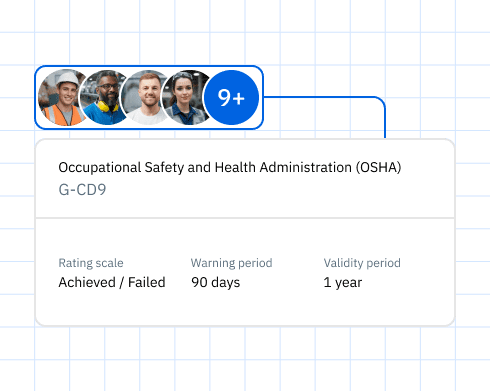
Regulatory pressure. ISO 9001, ISO 45001, and AS9100 all require documented evidence that employees are competent to perform their roles. This is not a checkbox exercise, these standards require you to define the required competence for each role, provide evidence of competence for every individual, and evaluate the effectiveness of actions taken to address gaps. Auditors are not interested in good intentions. They want records. A competency management system creates an auditable trail automatically, reducing compliance risk and dramatically cutting the time spent preparing for inspections.
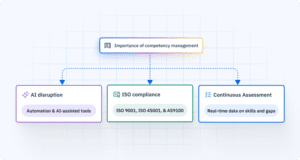
The collapse of annual review cycles. Progressive organisations have abandoned the annual performance review in favour of continuous assessment, and their competitors are following. That shift requires real-time data on skills and gaps, not a spreadsheet updated once a year and emailed to HR. Competency management provides the infrastructure for a continuous model to work: live skills data, automatic alerts when certifications expire, and a single record that every relevant stakeholder can access.
Key components of a competency management systemCopied
A competency management system is made up of several interconnected components. Organisations sometimes implement one or two of these in isolation, a skills matrix here, a training log there, and wonder why the results are patchy. The power comes from connecting them all into a single, integrated view of workforce capability. Understanding what each component does, and how they work together, helps you identify where your current approach has gaps and what a complete solution needs to cover.
Competency framework. The master list of competencies required across your organisation, structured by role, department, or function. It defines what ‘good’ looks like for every position and sets the standard that all assessments are measured against.
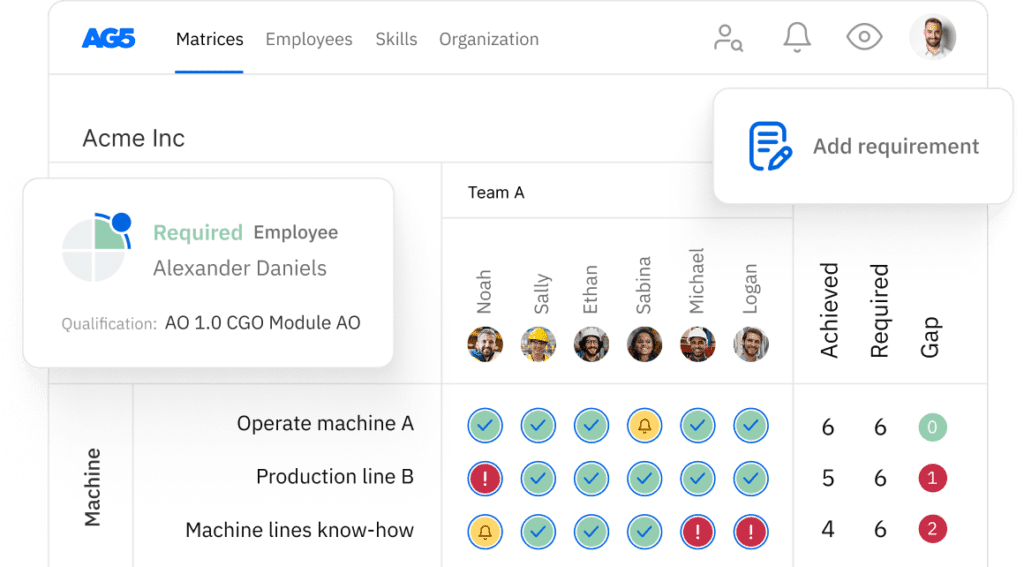
Skills matrix. A visual map of who can do what, and at what level. A well-maintained skills matrix template gives managers an instant view of team capability and highlights where the critical gaps are. It is the operational heart of competency management.
Competency gap analysis. A structured comparison of current proficiency against required proficiency. A thorough competency gap analysis tells you exactly where to focus training investment, and helps you defend that decision with data.
Training matrix. Once gaps are identified, the training matrix connects each gap to a specific learning intervention. It shows what training has been assigned, completed, and is due for renewal, particularly important for certification-based roles.
Assessment tools. Structured mechanisms for evaluating employee competence: manager observations, written assessments, practical sign-offs, or integrated third-party certifications. Dedicated competency assessment software automates this process and creates a timestamped, audit-ready record of every result.
Together, these components make up a full competency management system, and replacing any one of them with a spreadsheet introduces the same risks as using none of them at all.
Benefits of competency managementCopied
When competency management is implemented properly, the impact goes well beyond HR. Operations, quality, and compliance all benefit:
- Workforce optimization. Managers can see exactly who is qualified to operate which equipment or perform which process. Scheduling becomes skills-based, not assumption-based
- Audit readiness. ISO 9001 and ISO 45001 audits require proof of competence. A centralized system produces that documentation in minutes, not days
- Faster onboarding. New employees are assessed against the competency framework from day one. Gaps are identified early and training is assigned immediately, cutting the time to full productivity
- Reduced training waste. Generic training programmes disappear when you can see exactly what each person needs. Training spend goes where it has measurable impact
- Succession planning. When you have real-time data on every employee’s competence profile, identifying the next generation of team leaders and technical specialists becomes a structured process, not a gut-feel decision
A manufacturing team managing 500 workers across 66 skills does not have the option of estimating capability. The stakes, safety incidents, audit failures, production downtime, are too high. Competency management makes the invisible visible. And when it is built into a system rather than managed in spreadsheets, it also makes the visible actionable.
Common challenges, and how software solves themCopied
Most organisations already understand the value of competency management. The problem is execution. Managing competency data across a workforce of any meaningful size, even 50 people, quickly exceeds what manual processes can handle reliably.
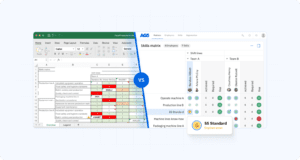
Here is what typically goes wrong when organisations try to manage it without dedicated software:
- Spreadsheet chaos. Skills matrices built in Excel quickly become unmanageable. Multiple versions circulate. Updates are missed. No one knows which copy is current
- Manual tracking at scale. Tracking certifications, expiry dates, and assessment results for hundreds of employees across dozens of roles is not a spreadsheet problem, it is a systems problem
- No single source of truth. HR has one version of competence data. Operations has another. Training has a third. When an auditor asks for proof of competence, no one can answer with confidence
Competency management software removes these problems by centralizing all skills data in one place, automating assessment workflows, sending alerts when certifications are due for renewal, and generating audit-ready reports on demand. The gap between knowing you need competency management and actually having it running is, in most cases, a software gap, not a planning gap or a people gap.
There is also a cost-of-delay question. Every month that passes with outdated skills data is a month where unqualified employees may be assigned to tasks they cannot safely or compliantly perform. For regulated industries, that is not a theoretical risk.
How AG5 supports competency managementCopied
AG5 is a dedicated competency management system built for manufacturing, aerospace, oil & gas and logistics organisations that need to manage skills at scale:
- Visual skills matrix. See every employee’s competence profile in a single, real-time view. Filter by role, team, site, or skill type
- Real-time gap tracking. Gaps are flagged automatically as assessments expire or roles change, no manual chasing required
- Audit-ready reports. Generate ISO-compliant competence records in seconds. Walk into any audit with full confidence
- Integrated training assignment. Connect gaps directly to training, so every development action is evidence-based and traceable
Ready to replace spreadsheets with a real competency management system? Book a demo to see how AG5’s competency management system works.
FAQs Copied
-
What is competency management?
-
What is the difference between competency and skills management?
-
What does a competency management system do?
-
Why is competency management important in manufacturing?
-
How do you build a competency management framework?
Author Copied

Revisions Copied
Written by: Rick van Echtelt
Copy edited by: Adam Kohut