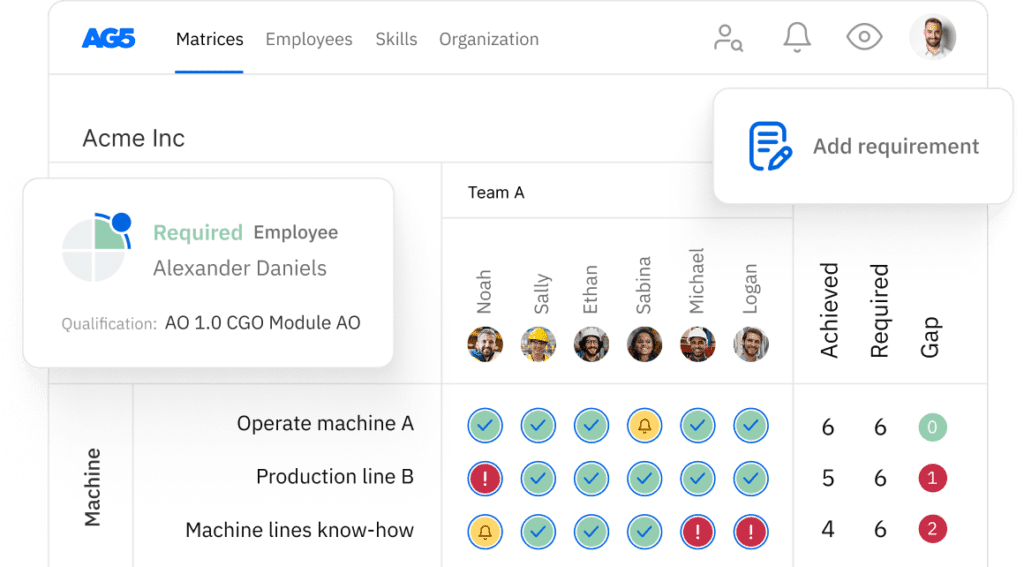
Mining skills management software for safety and compliance
Mining operations rely on fully qualified crews to maintain safety and compliance. Mining skills management software replaces spreadsheets with a centralized system to track training, certifications, and competencies across sites, identify gaps early, and generate audit-ready reports with confidence.

 Reviewed by Adam Kohut
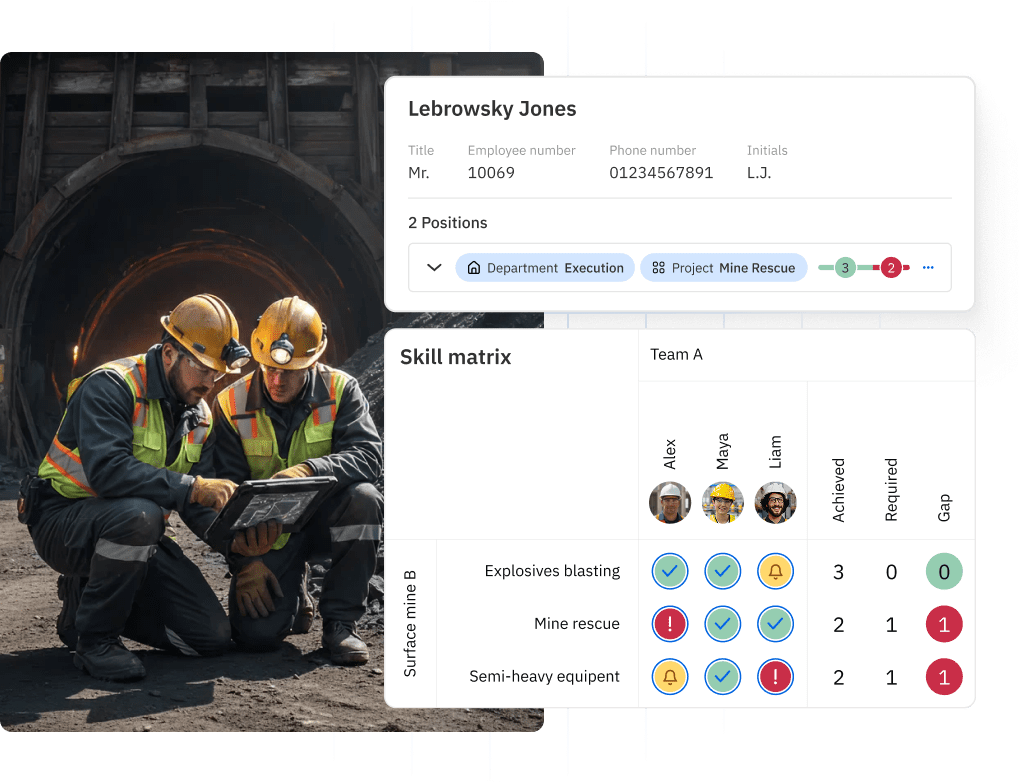
Mining operations face unique workforce challenges: distributed sites, complex regulatory requirements, high-risk environments, and continuously evolving technical demands. Managing skills, certifications, and training across these variables isn’t just an administrative task, it’s a safety imperative and a compliance necessity.
Traditional approaches to skills management in mining, typically spreadsheets scattered across departments and sites, create visibility gaps, increase administrative burden, and leave organizations vulnerable during audits. Mining skills management software offers a transformative alternative: centralized, real-time oversight of workforce competencies that supports strategic decision-making and operational readiness.
A revolutionary approach to mining skills managementCopied
The spreadsheet era of skills tracking is ending. Mining organizations are discovering that manual tracking systems can’t keep pace with the complexity of modern operations. When skills data lives in disconnected files, updated sporadically by different people across multiple sites, critical information becomes outdated before it’s even compiled.
AG5 replaces this fragmented approach with an intuitive, centralized dashboard that provides clear oversight of employee skills and certifications across your entire operation. Instead of chasing down information when you need it most, you have immediate visibility into who holds which qualifications, where skill gaps exist, and what training needs to be prioritized.
This shift from reactive administration to proactive skills management fundamentally changes how mining organizations approach workforce readiness. With a mining skills matrix template as your starting point, you can transition from spreadsheets to a dynamic, always-current view of organizational capability.
The strategic advantage of comprehensive skills visibilityCopied
Mining operations don’t stand still. New equipment arrives, processes evolve, regulatory requirements shift, site demands change, and workforce composition fluctuates. In this environment, strategic skills management isn’t optional, it’s how you maintain operational continuity while managing risk.
Mining skills management software transforms skills data from static records into strategic intelligence. When you can see the complete picture of workforce competencies in real time, you make better decisions about resource allocation, training investment, and operational planning.
Standardize skill definitions across your organization
One of the most persistent challenges in multi-site mining operations is inconsistent skill terminology. What one site calls “heavy equipment operation” another might categorize differently, creating confusion during transfers, audits, or emergency resource mobilization. Mining skills management software establishes consistent skill definitions across sites and crews, creating a shared language for competency that supports better communication and coordination.
Map competencies to operational requirements
Every role in mining operations requires specific technical competencies and certifications. Equipment operators need particular authorizations, maintenance technicians require specialized training, and supervisors must hold specific safety qualifications. A robust competency management system maps these requirements clearly, ensuring everyone understands what qualifications each role demands.
This mapping isn’t just about compliance, it’s about operational efficiency. When you know exactly what competencies are required for each task and role, you can:
- Assign work confidently, knowing personnel are qualified
- Identify development pathways for advancement
- Plan succession for critical roles
- Respond effectively to changing operational needs
Prioritize training based on real operational needs
Not all skill gaps carry equal weight. Some represent immediate safety or compliance risks, while others may be developmental opportunities for the future. Mining skills management software helps you distinguish between urgent training needs and longer-term development priorities based on actual operational requirements and risk assessments.
This data-driven approach to training prioritization means your investment in workforce development delivers maximum return. You allocate training resources where they matter most, closing critical gaps first while maintaining a strategic view of long-term capability building.
Skills tracking that supports safety and complianceCopied
In mining, safety isn’t negotiable, and neither is the evidence that proves your workforce is qualified to work safely. Regulatory bodies, insurance providers, and internal auditors all require clear documentation that employees hold current, valid certifications for the work they perform.
Traditional tracking methods struggle with this requirement. Spreadsheets don’t send alerts when certifications near expiration. Manual systems depend on someone remembering to check. File cabinets don’t provide instant access during surprise inspections. These limitations create real risk: operational disruptions when expired qualifications are discovered, compliance violations during audits, and most critically, safety exposure when unqualified personnel perform high-risk tasks.
Centralized certification evidence and access control
Mining skills management software centralizes all certification evidence in one secure system with consistent access control. Instead of scattered documentation across filing cabinets, email inboxes, and personal folders, every certificate, training record, and qualification proof lives in a single, organized repository.
This centralization delivers immediate practical benefits:
- Auditors can access required evidence quickly
- Supervisors verify qualifications before assigning tasks
- HR teams track training completion across sites
- Safety managers monitor certification status in real time
The system maintains authorized access consistently, ensuring sensitive personnel information remains protected while keeping necessary documentation available to those who need it.
Proactive expiration management
The most valuable feature of automated skills management may be its simplest: proactive notifications before qualifications expire. Instead of discovering expired certifications during audits or when assigning critical work, you receive advance warning that gives time to schedule renewal training.
These alerts don’t just prevent compliance issues, they maintain operational continuity. When you know which certifications will expire in the coming weeks and months, you can plan renewals during natural operational lulls rather than facing emergency training needs that disrupt production schedules.
Clear reporting for multiple audiences
Different stakeholders need different views of skills and certification data. Safety teams want to see qualification gaps that represent risk exposure. Operations managers need workforce readiness status by site and shift. Executive leadership requires high-level capability metrics. Auditors demand comprehensive evidence trails.
Mining skills management software generates clear reports tailored to each audience without requiring manual compilation. A few clicks produce documentation that would otherwise take days to assemble from scattered sources, supporting safety reviews, internal audits, and regulatory requirements with equal ease.
Understanding mining training requirements and regulations helps contextualize these reporting needs, while specific certification tracking, such as for MSHA certifications, demonstrates compliance in regulated operations.
Building a skills-ready mining workforceCopied
The ultimate goal of skills management software isn’t better record-keeping, it’s a more capable, safer, and more efficient workforce. When you have clear visibility into skills and qualifications, you can build that workforce strategically rather than reactively.
Close skill gaps before they become operational risks
Skill gaps aren’t just abstract concerns, they translate directly into operational constraints and safety risks. When a critical piece of equipment sits idle because no qualified operator is available, productivity suffers. Maintenance work is delayed when required certifications are missing. Safety is compromised when unqualified personnel attempt specialized tasks.
Mining skills management software makes these gaps visible before they become problems. You see which sites lack particular competencies, which teams have single points of failure in specialized skills, and which upcoming retirements will create knowledge gaps if not addressed proactively.
This visibility enables preventive action: targeted hiring, strategic training, cross-site resource sharing, and succession planning that maintains operational capability regardless of workforce changes.
Support career development and retention
Skills management isn’t only about filling gaps, it’s also about developing people. When employees see clear pathways for skill development and advancement, engagement increases and retention improves. Mining skills management software supports this development by making progression requirements transparent and tracking progress toward advancement goals.
Employees can see which competencies they need for the next role, supervisors can identify high-potential workers ready for additional responsibility, and HR teams can design development programs aligned with both organizational needs and individual aspirations.
Enable informed workforce planning
Strategic workforce planning requires accurate skills data. How many heavy equipment operators do you need across all sites? What specialized maintenance competencies will new equipment require? How will planned site expansions affect skill requirements? Which training investments deliver the best return in operational capability?
These questions can’t be answered confidently with fragmented, outdated skills information. A comprehensive skills matrix provides the foundation for workforce planning that aligns with business strategy, supports growth objectives, and maintains operational excellence as conditions change.
Implementation that respects operational realityCopied
The best skills management software in the world doesn’t help if your team won’t use it. Successful implementation requires systems that fit how mining operations actually work, not theoretical ideals that look good in demonstrations but fail in practice.
Start where you are
Most mining organizations already track skills somehow, even if current methods are inadequate. You might have a master spreadsheet, site-specific databases, or filing cabinets full of certificates. Effective skills management software works with these existing practices, providing a path forward that doesn’t require abandoning everything to start from scratch.
Beginning with a structured mining skills matrix template helps bridge from current state to future capability. You can migrate data gradually, validate accuracy during transition, and build user confidence with quick wins before tackling more complex integration.
Design for actual users
Mining operations span diverse users with different technical comfort levels, access to technology, and time availability. Surface workers may have limited computer access. Supervisors balance multiple responsibilities. Safety managers juggle compliance requirements. HR teams coordinate across sites.
User-friendly mining skills management software accommodates this reality with intuitive interfaces that require minimal training, mobile access that works in the field, and workflows that align with how different roles actually work rather than imposing one-size-fits-all processes.
Integrate with operational workflows
Skills management can’t be a separate activity that competes with operational priorities, it needs to integrate seamlessly with existing workflows. When certifications expire, no one notices until work has already been completed. Skill gaps only surface once production is scheduled. Staffing constraints become clear just as a shift is about to begin.
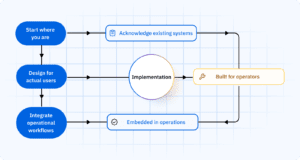
This integration happens when skills management software connects with other systems already in use: HRIS platforms, learning management systems, scheduling software, and maintenance management tools. The result is skills data that stays current because updating it becomes part of normal operations rather than additional administrative burden.
Making the transition to modern skills managementCopied
Moving from spreadsheets and paper files to comprehensive skills management software represents significant organizational change. Success requires more than just buying the right technology, it demands thoughtful implementation that builds capability while maintaining operations.
Secure stakeholder buy-in
Different stakeholders care about different aspects of skills management. Operations managers want assurance that workforce capability won’t be disrupted during transition. Safety teams need confidence that compliance won’t be compromised. IT departments require integration planning. Finance wants ROI justification.
Successful implementation addresses each stakeholder’s priorities explicitly, demonstrating how modern skills management delivers value relevant to their concerns. When operations sees better workforce visibility, safety sees stronger compliance support, IT sees straightforward integration, and finance sees efficiency gains, organizational support follows naturally.
Plan for data quality
Your skills management software is only as valuable as the data it contains. Implementation planning should address data accuracy, completeness, and ongoing maintenance explicitly. This often means:
- Conducting skills audits to establish baseline accuracy
- Defining clear processes for updating information
- Assigning accountability for data quality
- Building verification into operational workflows
- Planning regular data reviews and cleanup
Strong data governance from the start prevents the “garbage in, garbage out” problem that undermines many technology implementations.
Train users thoughtfully
Technology training often focuses on features and functionality: “Here’s how you click through these screens.” More effective training emphasizes purpose and context: “Here’s why this information matters and how it helps you do your job better.”
When users understand how skills management software makes their work easier, not just different, adoption accelerates. Supervisors who see how quick qualification verification prevents assignment mistakes become advocates. Safety managers who experience streamlined audit preparation become champions.
The future of mining workforce managementCopied
Mining operations face mounting complexity: aging workforce demographics, evolving regulatory landscapes, technological advancement, and changing operational models. Traditional approaches to skills management can’t keep pace with these pressures.
Mining skills management software isn’t just about better record-keeping, it’s about building organizational capability for an increasingly demanding environment. When you have clear visibility into workforce competencies, gaps become opportunities, compliance becomes manageable, and strategic workforce planning becomes possible.
The organizations that will thrive in mining’s future are those that treat workforce capability as a strategic asset deserving the same management rigor as equipment, capital, and reserves. Skills management software provides the foundation for that approach, transforming scattered data into strategic intelligence that drives better decisions at every level.
See how AG5 can simplify mining safety and training complianceCopied
Mining skills management software transforms workforce capability from an administrative burden into a strategic advantage. With AG5, you gain real-time visibility into skills and certifications across all sites, identify and close gaps proactively, and maintain the audit-ready documentation that mining compliance demands.
Discover how it works with automated certification tracking, expiration alerts, and comprehensive reporting that keeps your operation running safely and efficiently.
Get a demo now to see how AG5 tracks competencies, highlights training needs, and supports the skilled, compliant workforce your mining operation requires.
FAQs Copied
-
What is mining skills management software?
-
How does AG5 help with mining compliance?
-
Can we start from an Excel mining skills matrix?
-
How does skills management software improve safety?
-
What's the ROI of mining skills management software?
-
How long does implementation take?
Author Copied

Revisions Copied
Written by: Rick van Echtelt
Copy edited by: Adam Kohut